Essay I
The Gate Before Dawn
An hour early at a boarding gate before first light, and the strange work of being, for a while, a person whose only purpose is to wait.
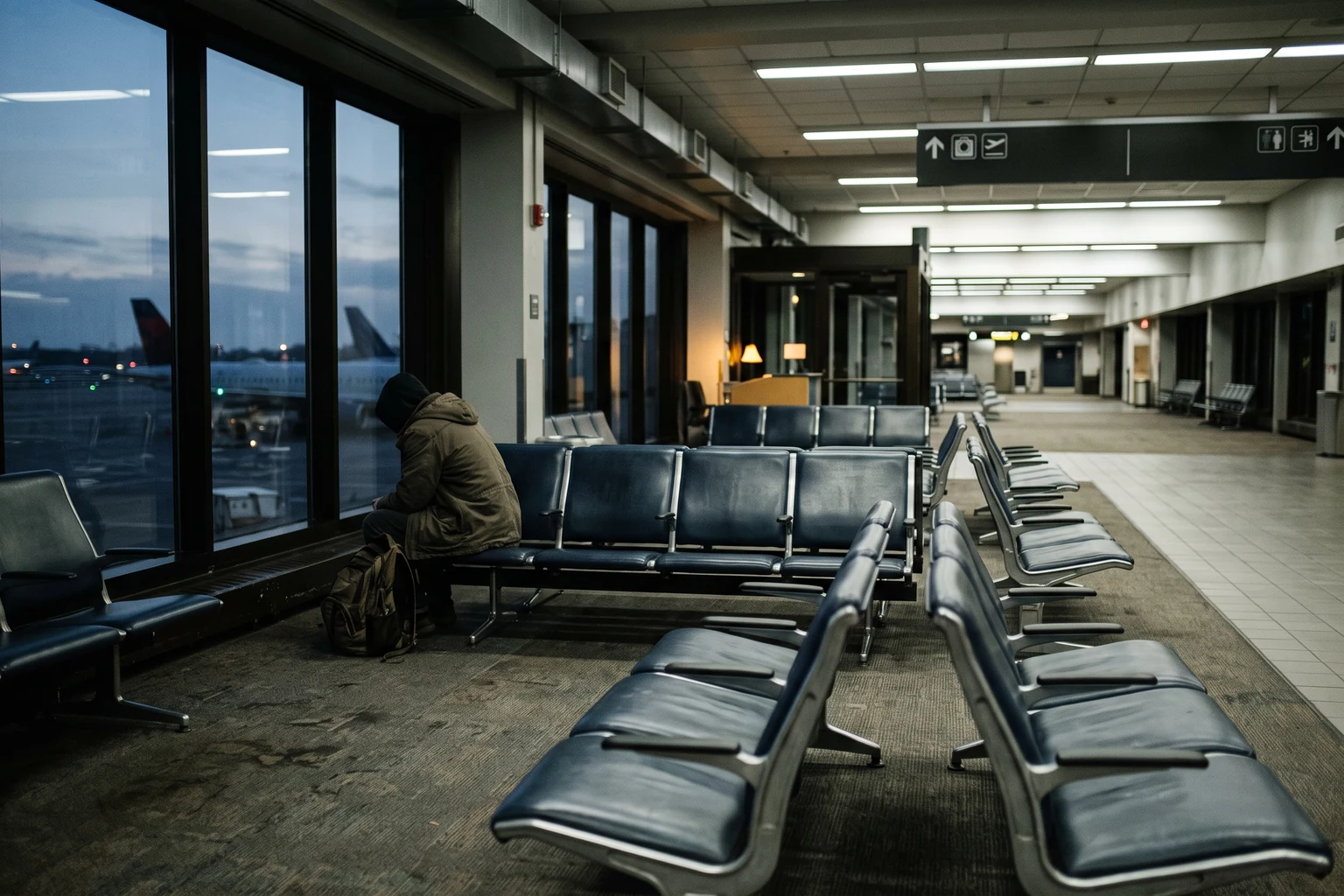
You get to the gate with an hour to spare because you always do, and you sit down in one of the fixed rows of hard chairs bolted together in lines, and you become, for a while, a person whose entire purpose is to wait. It is not yet light outside the great windows. The apron is a field of blue and amber lamps and slow-moving vehicles, and beyond it the runway lights run off into a dark that is just beginning, at one edge, to go grey. Inside, under the flat ceiling lights, thirty or forty strangers sit in the same rows facing the same direction, and wait, and do not speak.
There is a specific suspension to it. You have left the place you were and not yet arrived at the place you are going. You are through security, stripped of your belt and your liquids and a certain amount of your dignity, committed now to a journey that has not begun. Behind you is the city you came from, already receding, no longer quite yours. Ahead is a city you cannot yet picture, hours away, on the far side of a flight. And here, in between, is the gate — not a departure and not an arrival, a held breath, a room whose only content is the interval before something happens.
Everyone faces the same way. That is the thing I notice every time. In an ordinary room people arrange themselves in all directions, toward each other, around tables, in the loose geometry of company. At the gate we all sit in rows pointed at the same wall — at the desk, at the door that is still shut, at the screen above it that governs everything. We are oriented, all of us, toward the same future event, aligned like iron filings by the pull of the same departure, and we trust — this is the quiet astonishing thing — we trust the screen. It says the flight is on time, and we believe it. It says the gate is this one, and we came here on its word. A little illuminated panel tells forty strangers where to point their lives for the next hour, and they do, without question, because at the gate the screen is the only oracle there is.
The light comes up slowly beyond the glass. The grey at the edge of the sky spreads and warms, and the apron lamps begin to look weaker against it, and a plane pushes back somewhere and turns, its lights wheeling. Nobody watches the dawn. Everyone watches the desk, the door, the screen. A staff member arrives and does something at the terminal and a low current of readiness moves through the rows — people gathering bags, checking passes, though nothing has been announced. We have learned to read the signs. We are all waiting for the same permission, and we will all rise at nearly the same moment when it comes, and file toward the same door, and be gone.
I find these hours strangely peaceful, for all their deadness. There is nothing to do and nothing you can do; the waiting is total and imposed and shared, and there is a relief in a passivity so complete. You cannot hurry the flight. You cannot leave. You can only sit in the row, facing the door, in the grey hour before the day, among strangers all suspended in the same interval, all trusting the same screen, all pointed at the same not-yet — and let the time pass over you, unfilled, until the voice comes over the speaker and the held breath is finally let go.
Word, when there is word.