Essay II
The Thing That Sank
A corroded green lump raised from a two-thousand-year-old wreck—and the astonishing, half-understood machine found sleeping inside it.
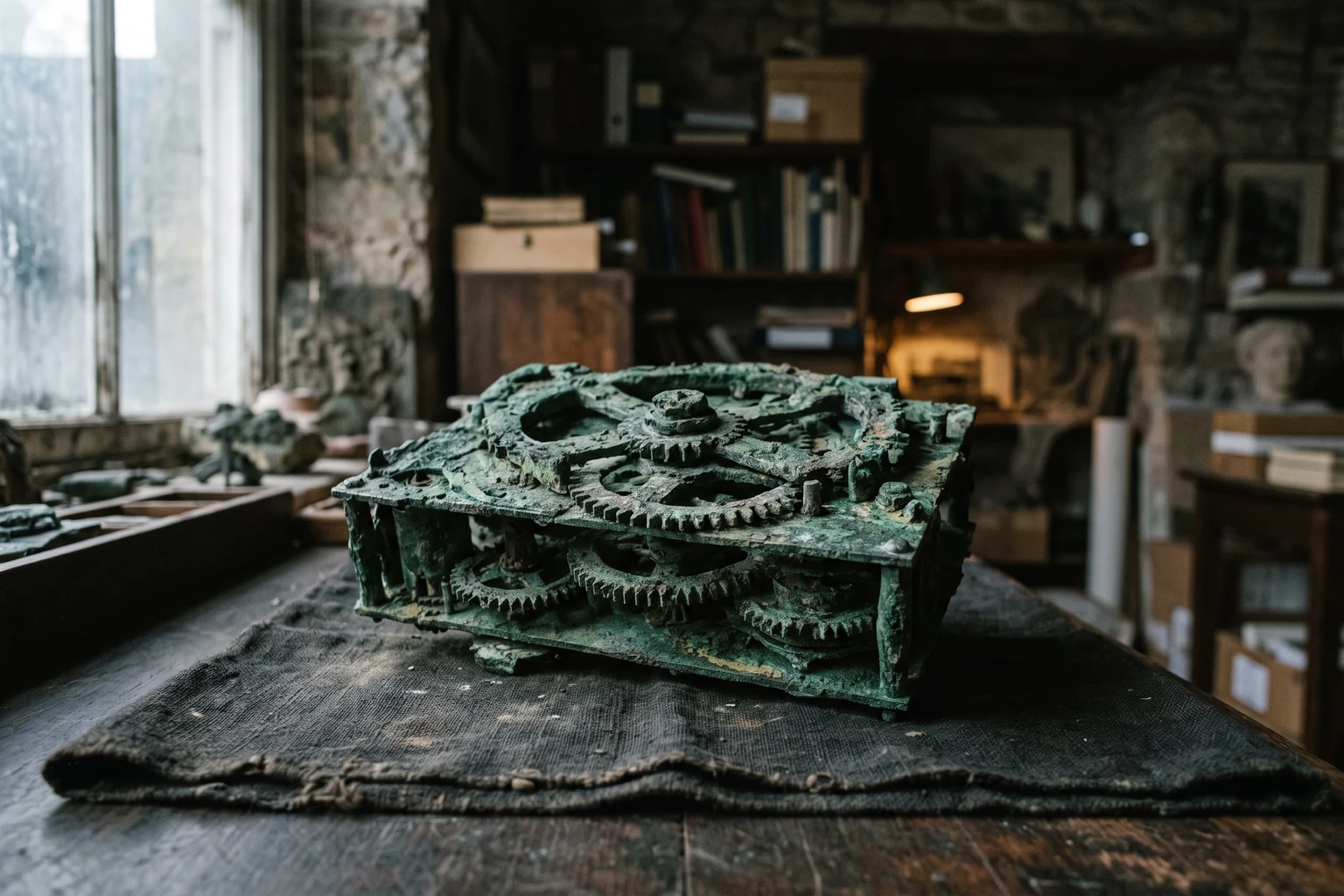
In 1901 sponge divers, sheltering from a storm off a small Greek island called Antikythera, went down onto an ancient wreck and brought up bronze and marble — statues, coins, the usual cargo of a Roman-era ship that had gone down two thousand years before. Among it all was a corroded lump the size of a book, green and shapeless, easy to overlook beside the statues. It sat in a museum drawer while more glamorous things were cleaned. Then, one day, the lump cracked, and inside it someone saw a gearwheel.
Not a rough one. A precise one, cut with triangular teeth, meshed with others, part of a mechanism of thirty-odd bronze gears fitted together in a wooden case no bigger than a mantel clock. It took the better part of a century, and finally X-rays that could see through the corrosion into the fused interior, to work out what it did. It was a calculator of the heavens. You turned a handle, and the gears turned, and dials on the faces showed you the position of the sun and moon, the phase of the moon rendered by a little half-silvered ball, the dates of eclipses, the timing of the games at Olympia. It modelled the wandering of the planets. It even accounted, with a clever pin-and-slot, for the moon’s speeding up and slowing down across its month.
Nothing else like it survives from the ancient world. Nothing close. The next device of comparable intricacy that we can point to comes more than a thousand years later, in the geared astronomical clocks of medieval Europe. For a millennium and more, the ability to build such a thing was simply not present on the earth — or if it was, no trace of it remains. Somewhere in the Greek world there were hands that could cut those teeth and a mind that could lay out those trains of gears, and that knowledge went down with a ship, or faded out some other way we cannot see, and did not come back for a very long time.
This is the part that unsettles the modern assumption, the one that runs quietly under everything: that knowledge accumulates, that we are always the most advanced there has ever been, that the arrow of capability points only upward and forward. The mechanism says otherwise. Sophistication can be reached and then lost. A whole art can flourish in a few workshops, produce a marvel, and vanish so completely that when its one surviving example is pulled from the sea, we cannot at first believe it is what it is — some have insisted, on first seeing it, that it must be modern, dropped onto the wreck by accident, because surely they could not have made this.
They could. They did. And then the making was gone, and stayed gone, while the one that survived lay under a hundred feet of water and two thousand years of sediment, its bronze slowly seizing into a green lump, its gears fusing into a solid mass, waiting for a storm to drive some divers onto exactly that reef.
What I take from it is a lowering of the usual confidence, and I think a healthy one. We imagine our own knowledge is safe because it is so vast and so copied. But vastness is no guarantee, and the ancients thought their arts secure too, presumably, right up until the ship went down. The patience it took to reconstruct the thing — the decades, the imaging, the slow reading of gear-teeth counts to infer the astronomy they encoded — is the mirror image of the ease with which it was lost. It sank in an afternoon. It took a century to begin to understand. And most of what that workshop knew is down there still, in the dark, in the silt, in no drawer anyone will ever open.
Word, when there is word.