Essay VI
The Drawer of Cards
The old library drawer of cards, and the serendipity it manufactured—the book you left with never quite the one you came for.
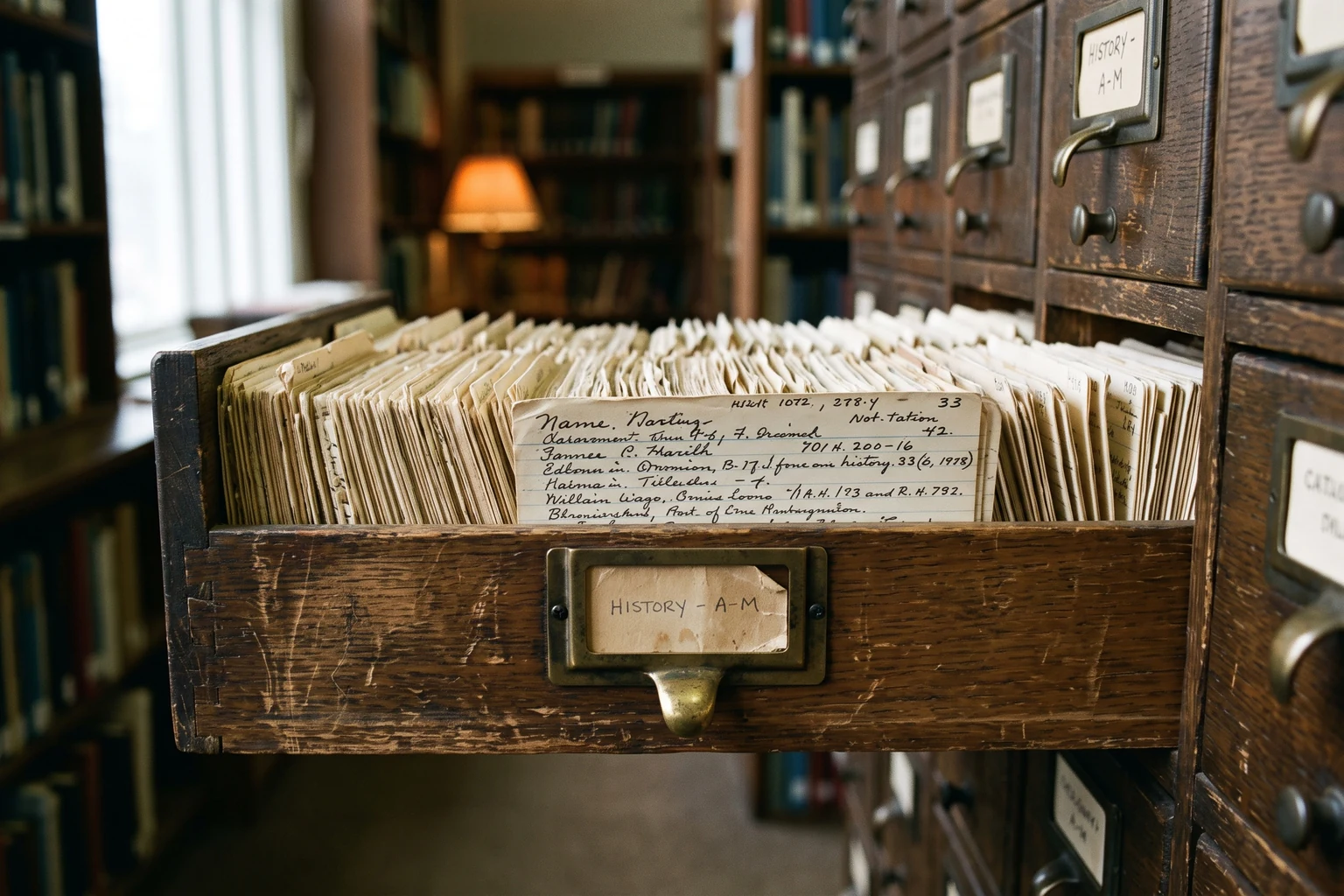
There was a piece of furniture that used to stand at the heart of every library, and a whole way of knowing that went with it, and both are nearly gone now. The card catalogue: a great cabinet of small shallow drawers, each one packed with cards, each card a single book, arranged by author and by subject and by title, and the way you found what you were looking for was to walk to it, and pull out a drawer, and thumb through the cards with your fingers, one after another, reading as you went.
It was slow, and that was not entirely a fault. You went to the drawer for one thing and you found it, yes — but on the way to it your fingers walked past a hundred other cards, and your eye caught on them, and again and again the book you left with was not the book you came for. You were looking up one author and the card in front of it, filed by the accident of alphabet, was a book you’d never heard of on a subject next to yours, and you pulled it, and it changed the direction of your afternoon, or your thinking, or once in a while your life. The catalogue was full of these accidents. Its very structure — physical, sequential, browsable, forcing you to pass through the neighbours of the thing you wanted — manufactured serendipity as a by-product of how it worked.
The search box has engineered that away, and engineered it away on purpose, and calls the removal an improvement. Now you type exactly what you want and receive exactly that, and nothing else, and receive it instantly, and this is genuinely better in every way but one. You no longer walk past the neighbours. There is no drawer to thumb through, no accident of adjacency, no card catching your eye on the way to the card you meant to find. The search gives you what you asked for, which means it can only ever give you what you already knew to ask for — and the whole education of the old catalogue was in the things you did not know to ask for, the ones you stumbled on because the physical act of searching dragged you past them.
I do not want to be foolish about this. I have looked up more in a lifetime than the old catalogue could have given me in ten, and found it in seconds, and been grateful. The search box is a marvel and I use it a hundred times a day. But I notice what it has quietly cost, which is the productive inefficiency of having to move through knowledge with the body — walking to the cabinet, pulling the drawer, letting the fingers browse, stumbling sideways into the unexpected. The friction that the search box removed was not only waste. Some of it was the very thing that made the library a place of discovery rather than mere retrieval, a place you went to find what you weren’t looking for.
There is a difference, in the end, between retrieval and discovery, and we have optimised entirely for the first at the expense of the second. Retrieval is getting the thing you sought. Discovery is being met, on the way, by the thing you didn’t know existed. The card catalogue was slow, and physical, and inefficient, and it was a great engine of discovery precisely because of those faults — because it made you walk, and browse, and pass the neighbours, and stumble. The drawers are mostly gone now, sold or skipped or kept as curiosities holding seed packets and spare keys. And we get exactly what we ask for now, instantly, always — and are never again ambushed, in the good way, by the card we were never looking for.
Word, when there is word.