Essay IX
The Sound of Stone
The silence that meets you in an empty old church: a hush with size to it, and the way stone gives sound its shape.
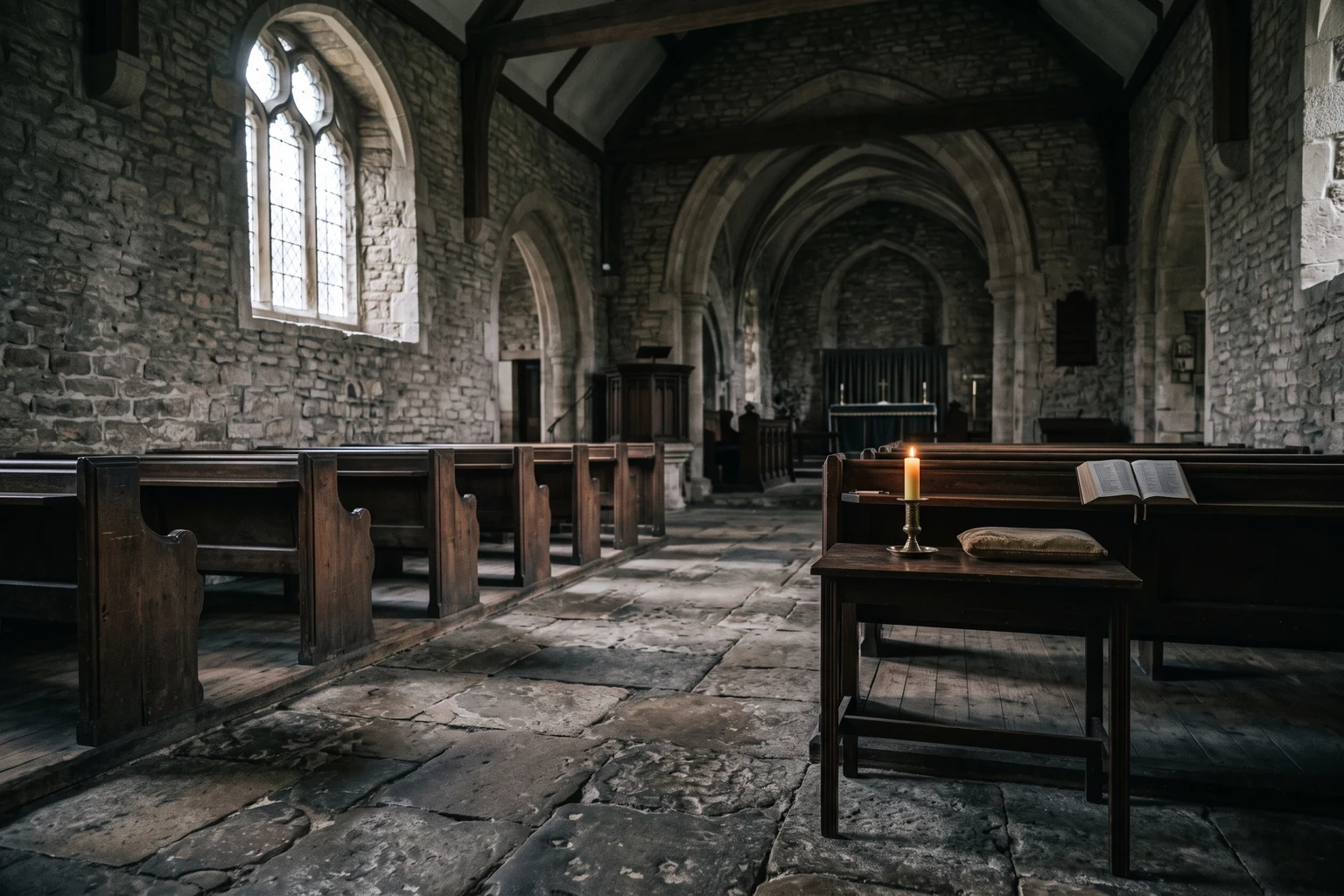
Walk into a great old church when it is empty and the first thing that meets you is not what you see but what you hear, which is almost nothing, and that nothing has a size. The door shuts behind you and the noise of the street is gone, and in its place is a silence that is somehow vast, a hush with depth and volume to it, the sound of a great space full of still air under a stone roof. And then you scrape a shoe on the flags, or cough, or let a word escape, and it does not fall dead the way a word does in your kitchen. It travels. It swells and hangs and rolls up into the vaults and comes back to you softened, from everywhere at once, seconds later, so that you have the distinct sensation of having been answered by the building itself.
This is not an accident, and it is not only a by-product of building big in stone. The people who raised these places understood sound, understood it in their hands and ears without the mathematics we would now use, and they tuned their buildings as surely as a maker tunes an instrument. The long reverberation that blurs speech into a wash was no defect to them — it was the point. Plainchant was written for it, a slow unhurried single line of voices that needs exactly that lingering echo to bloom, each note still hanging in the vaults as the next arrives, the building sustaining and thickening the sound into something no single throat could make. Sing the right music in the right stone room and the room becomes part of the choir.
And the reverberation does something to the person standing in it, something the builders surely intended. It makes you feel small, and it makes you feel it in the right way — not humiliated but dwarfed, set properly against a bigness, your own small sounds gathered up and magnified and returned to you by a space that plainly exceeds you. A whisper is not private here; the stone overhears it and passes it on. A footstep announces itself to the whole nave. You lower your voice without deciding to. You move more slowly. The acoustics reach into the body and adjust its bearing, tuning the person as the building was tuned, until you stand and speak and breathe differently than you did out on the street — smaller, stiller, more careful, more aware of being one small sounding thing inside a very large silence.
There is a craft in silence, too, which we mostly forget. A room can be built to hold a silence as deliberately as to hold a voice, and the great churches hold both — the roll of the organ that shakes the chest, and the enormous poised quiet between, a quiet that is not empty but full, charged, expectant, a silence with the memory of sound still in it and the promise of more to come. To sit alone in that stillness is to be held by an emptiness that has been shaped, over centuries, to make a particular kind of feeling possible: the feeling of being small in the presence of something large, and finding it not a terror but a rest.
We do not build for the ear like this anymore. Our rooms are designed to deaden sound, to soak it up, to keep every space small and dry and private and legible, so that the voice falls flat at the lips and travels nowhere and asks nothing of the body. The old builders did the opposite. They made rooms that answer you, that take your small sound and enlarge it and hand it back, that use the plain physics of stone and air and volume to do to a standing human being what no words could do — to make him feel, in his own body, the size of the thing he has walked into, and to lower his voice, and to wait.
Word, when there is word.