Essay XI
Ruins of a Sold Future
A ruin not of stone but of tarmac and tile: the dead shopping mall, and what it says that our newest ruins are the ones built to last least.
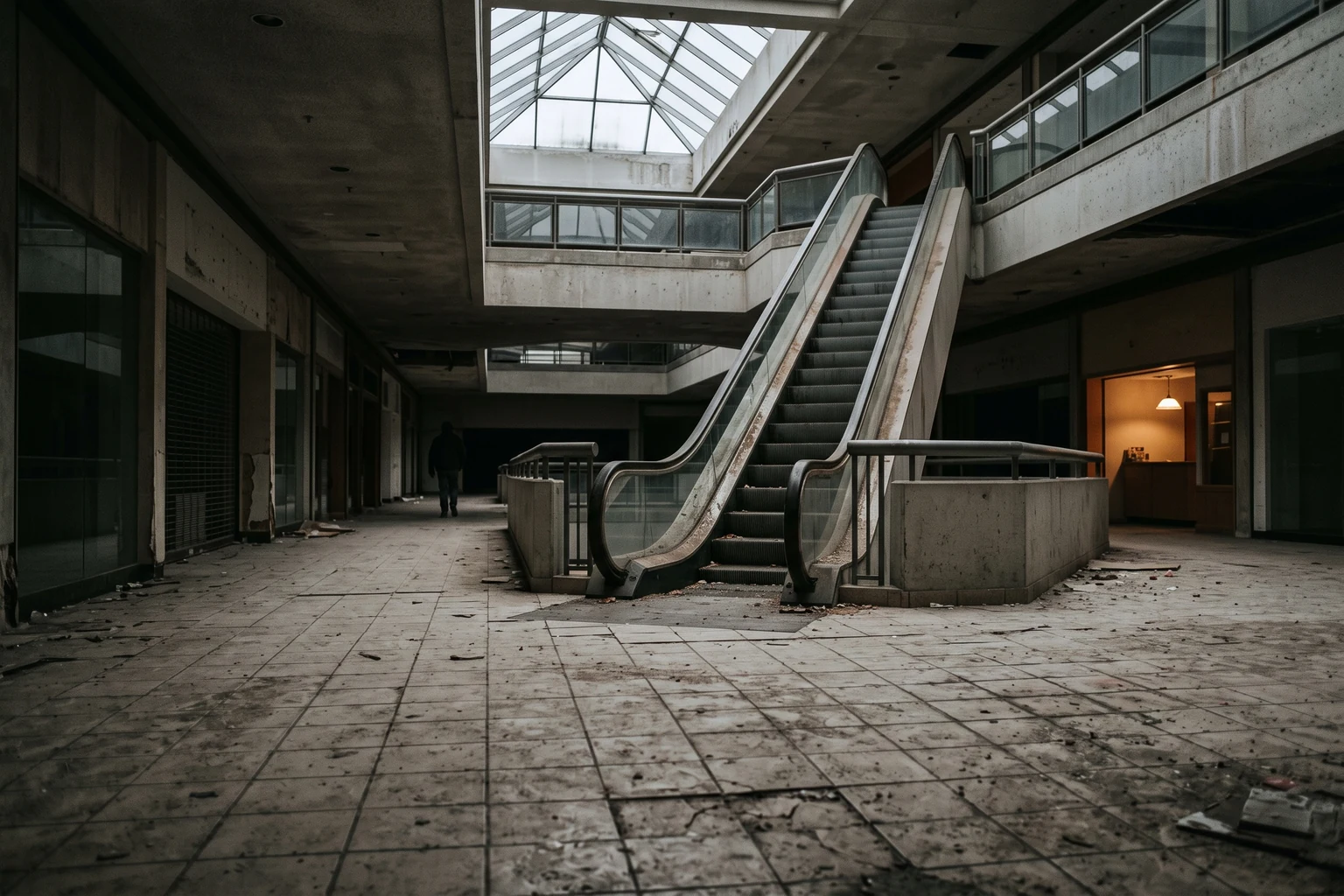
There is a particular kind of ruin being made now, and it is not made of stone. Go to the edge of a town where the money moved on, and you will find it: a shopping mall, thirty or forty years old, mostly empty. The great car park half-grassed with weeds pushing up through the splitting tarmac. Inside, the long tiled concourse still lit, still faintly playing music, the fountains dry, two-thirds of the units behind steel shutters or papered over, a few holding on — a phone-repair kiosk, a discount store, a charity shop in a space built for something grander. The skylights still let down their pale even light onto benches where almost no one sits.
They were sold to us as the future. I am old enough to remember when a new mall opening was an event, when this was plainly where the world was going — climate-controlled, seamless, everything under one roof, no weather, no distance, no friction between wanting and buying. You would park once and glide from shop to shop on the polished floor, past the fountains and the potted palms, and it was meant to be effortless, and that was the whole pitch. Effortlessness. The removal of every small resistance that a high street, with its rain and its distances and its separate doors, still put between you and your purchases.
And now they are dying, and dying in a particular way — not blown down or burned, just abandoned, out-competed by a frictionlessness even greater than their own. The mall promised to save you the walk down the high street; the screen in your pocket promises to save you the walk to the mall. Each new smoothness undercuts the last. The thing that killed the high street has itself been killed by the thing that killed distance altogether, and what it leaves behind is this: a vast lit box, built to be the future, standing mostly empty in the actual future, which turned out to have no use for it.
There is a whole quiet fascination with these places — people who photograph them, who walk their echoing concourses recording the music still playing to nobody, the dead escalators, the fountains gone dry. A morbid pursuit, you might say, and yet I understand it entirely. A dead mall is a ruin of a specific and recent dream, and ruins of dreams are always the most affecting kind. A ruined castle speaks of a power that is gone. A ruined mall speaks of a promise that failed — the promise that convenience, endlessly refined, would be enough; that if you removed every friction, people would come and keep coming; that seamlessness was a thing you could build a cathedral to and expect it to last.
It didn’t last. That is what the empty concourse says, more clearly than any lecture could. The frictionless is not permanent. It is only ever the newest arrangement, waiting to be undercut by a smoother one, and the monuments we raise to it date faster than almost anything, because they are built out of a convenience that the next convenience will make quaint. The stone temple lasts three thousand years as a ruin. The temple of shopping lasts thirty as a going concern and then becomes this — the tiled floor, the papered windows, the music playing, the light coming down through the skylights onto the empty benches, a future we were sold, standing vacant, in the middle of the one that actually came.
Word, when there is word.