Essay XX
The Hand Grinder
Beans clattering into the hopper like rain on tin, the folding handle, and the whole of the morning's promise ground out by hand.
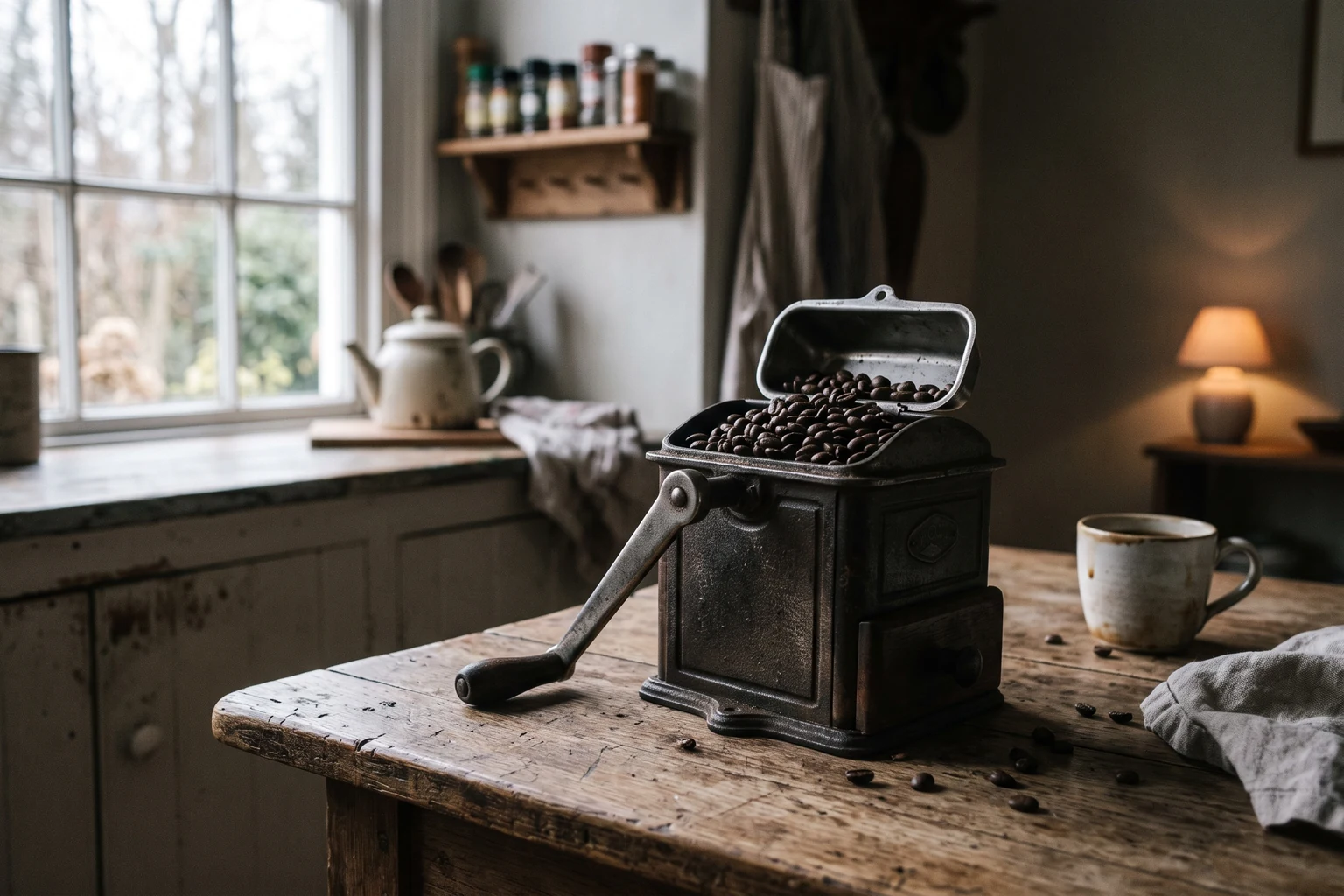
The beans go in with a sound like rain on a tin roof, a dry clatter as they tumble into the hopper and settle. You breathe in over the top of it — that first smell, still closed and dark, the whole of the morning’s promise packed into something that hasn’t happened yet. Then the lid, and the little folding handle swung out on its pin, and the whole cold weight of the thing braced against your body, held in the crook of an arm or clamped between the knees the way you’ve settled on over the years.
The first turn is the honest one. There’s real resistance in it — the burrs meet the first beans and the handle stops being free, and you feel the crush transmit up through the crank and into your wrist and forearm, a lumpy, grinding, granular resistance that isn’t smooth at all. Each bean is a small event. You can feel them going one at a time, or two, a series of tiny fractures, a crunch you feel more than hear, the bean shattering somewhere down in the mechanism and the fragments dragged between the burrs and broken smaller, and smaller.
You settle into the crank. The wrist finds its circle. There’s a rhythm the arm wants, not fast, and if you push it too hard the beans just chatter and skip in the throat of the grinder and nothing feeds; you have to let it take them at its own pace, the burrs pulling the beans down and biting, the handle rising and falling under a resistance that comes in waves. Turn, and crunch, and turn. Your shoulder warms. There’s a faint heat coming off the mechanism now, the warmth of friction and of your own effort, and with the heat comes the smell — really comes, blooming up out of the grounds as the oils break open, no longer closed and dark but full, round, almost sweet, filling the space in front of your face.
This is the thing the button can’t give you. Somewhere there is a machine that would do this in four seconds with a scream of its motor, and you’ve heard it, the violence of it, done before you’d finished deciding you wanted coffee. The crank takes a minute, more. A slow minute, measured out in the ache building along the top of your forearm, the small burn of a muscle doing a thing it doesn’t do the rest of the day. You can’t hurry it and you can’t outsource it to the wrist of anyone but you. The effort is the price and the effort is also, somehow, part of what you’re making.
As you go the resistance eases. This is how you know you’re near the end — the handle spins freer, the crunch thinning out, fewer beans left to break, until the last few go through with a light gritty stutter and then the crank runs almost loose, turning on nothing, and you do a few more just to be sure, feeling for the last stubborn bean, and there’s none. The arm keeps its readiness for a second after the work stops, the way it does.
You pull out the little drawer at the bottom and it’s heavier than you expect, packed with grounds, and warm — genuinely warm, the heat of the grinding held in the fine dark powder. You put your face to it. Now it’s everything, the full smell, the smell that a whole-bean bag only hints at through the foil, released all at once because you broke it open with your own arm. The grounds are soft and fine and cool at the surface where the air’s got to them and warm underneath, and they hold the shape of the drawer when you tip them, a dark cast of the space they filled.
Then the water, and the rest of the morning. But this part — the cold weight braced against you, the beans going one by one under the burrs, the ache and the heat and the smell climbing up as you turn — this part your body did, all of it, in a minute that couldn’t be shortened, for a cup that will be gone in ten.
Word, when there is word.