Essay XXVII
The Question Left Standing
A cipher sculpture in a courtyard at the CIA, three passages read and the fourth unbroken for decades: the question left deliberately standing.
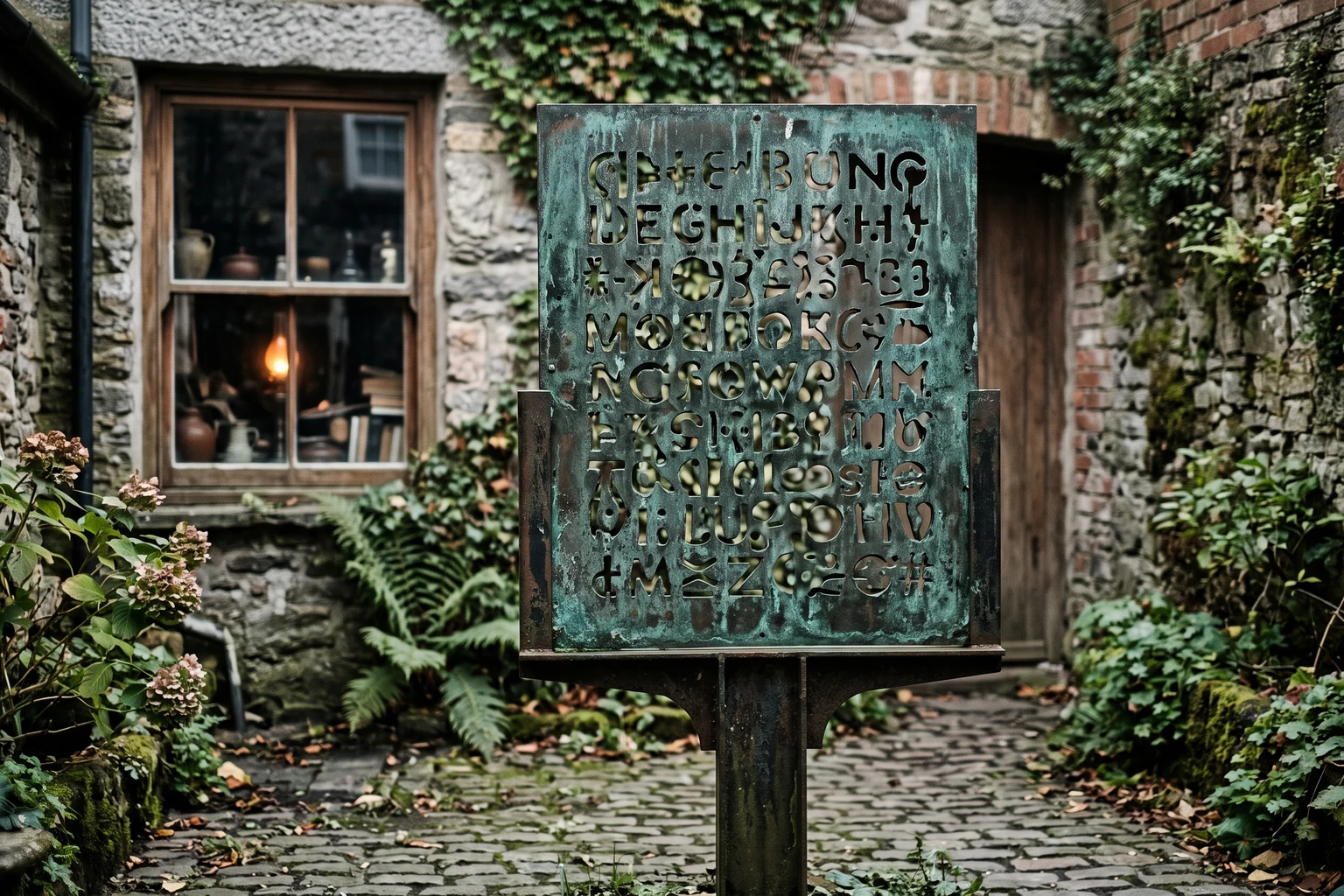
In a courtyard at the headquarters of the CIA, in Virginia, there is a sculpture. A curving copper screen, verdigris-green, punched through with letters — nearly two thousand of them, in four blocks of ciphertext. It is called Kryptos, and the artist who made it in 1990 encoded four passages into it, and gave the key to no one but, reportedly, the director at the time, and set it there in the most watched, most cleared, most cryptographically capable place on earth, and let it stand.
Three of the four passages have been broken. It took years — the world’s best code people, inside the fence and out, working at it in their own time — but three came apart, yielding a slightly misspelled riddling English, half poetry and half instruction. The fourth has not. Thirty-odd years on, ninety-seven letters at the end of the sculpture have kept their silence against everyone. The artist, now old, has released a clue or two, a handful of plaintext letters here and there, as if to keep the hunt alive, or to reassure the hunters that there is in fact something there to find. And still it holds.
There is a companion legend, the Beale ciphers, older and stranger: three coded papers said to give the location and contents of a buried treasure somewhere in Virginia, one of them decoded — using the Declaration of Independence as its key — into an inventory of gold and silver, the other two, the ones that would actually tell you where, stubbornly unbroken since the nineteenth century. People have dug up whole hillsides over them. And the live possibility, argued seriously, is that the whole thing is a hoax — that there is no treasure, that the unbroken papers are gibberish, that generations of treasure hunters have been decoding their lives away over a cipher that guards nothing whatsoever.
I keep both of these close, and it is the same thing I love in each. A deliberately unsolved thing. Not a secret that circumstance happened to bury — a language whose speakers died, a mechanism that sank — but a silence made on purpose, set down in front of us as a standing invitation and a standing refusal at once. Here is a question, the sculpture says. I will not tell you the answer. I may not even have arranged for there to be one.
That last part is the vertigo of it. With Kryptos we at least know the artist had a plaintext in mind. With Beale we do not even know that — the thing you are straining to solve may be a wall with nothing behind it, and there is no way, from the outside, to tell a fiendishly good cipher from random noise dressed up to look like one. You could spend a lifetime on it and never know whether you failed to solve it or whether there was never anything to solve. That is a peculiar kind of dignity to build into an object: to make a question that can outlast not only every person who tries to answer it, but any certainty that it was ever a question at all.
We are impatient with such things now. We want the answer key, the reveal, the thread where someone finally posts the solution. And these sit there and decline. The artist will die with the fourth passage still locked, most likely, and then it will be truly sealed — the one person who could confirm any solution gone, so that even a correct answer, should someone ever find it, could never again be checked against the source. The green copper will go on holding its ninety-seven letters up to the Virginia weather, a question with no one left to grade it, outliving, as the best questions do, everyone who ever stood in front of it and wanted so badly to know.
Word, when there is word.