Essay XXXIV
Chopping Onions
The cool papery onion, the loose edge of the skin worked back to the wet gleam beneath, and the plain attention chopping asks and gives.
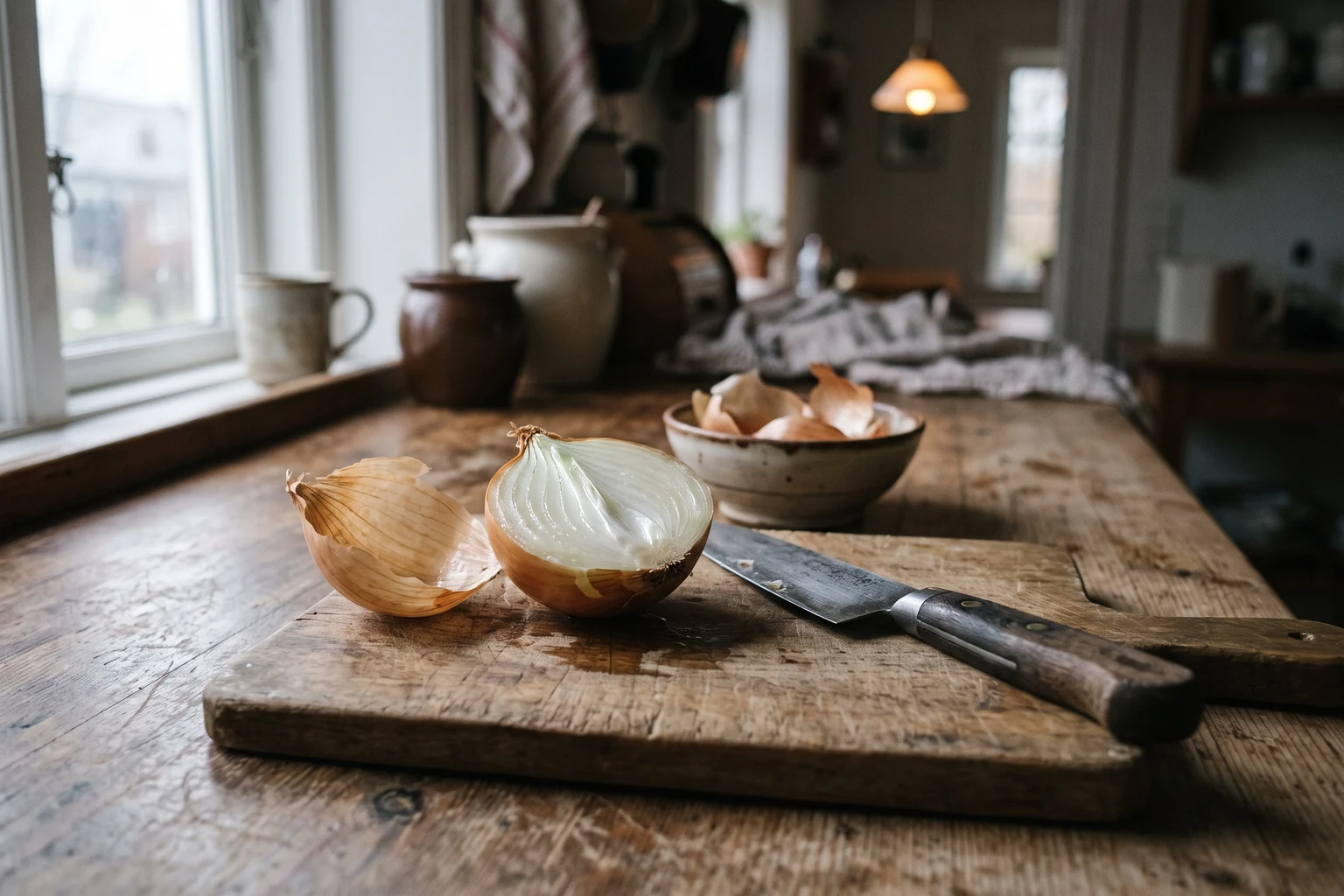
You take the onion in your hand and it’s cool and dry, papery, the skin crackling like the thinnest possible parchment where your thumb catches it. There’s a satisfaction in the peel — finding the loose edge near the root, working it back, the brittle outer layers giving way to the tight wet gleam underneath. The onion in your palm now is pale and faintly gold and it squeaks a little against your skin, cold with its own stored water, heavier than it looks.
The first cut is the loud one. The knife goes down through the top and the onion splits with a crisp, wet, tearing sound, a sound with fluid in it, and the two halves rock apart on the board and lie there showing their rings. Already the air has changed. You feel it before you understand it — a faint prickle high in the nose, at the back of it, a thin brightness in the air that wasn’t there a second ago.
You lay a half flat, the cut face down, and it sits solid and stable, sweating slightly onto the board. Slices one way, close together, the knife tip anchored, the blade rocking. Then the turn, and slices across, and the onion falls apart into small wet dice that catch the light and slide against each other. The rings within rings come undone. Juice beads up on the board and runs toward the edge.
By now the eyes have started.
It isn’t pain, quite. It’s more insistent than that, and more honest. A stinging that climbs up from somewhere below thought, and then the wet — the eyes filling at the rims, the first spill down the side of the nose, and you blink and it only makes it worse. You’re crying. Standing at your own counter on an ordinary evening, dicing an onion for a stew, and your body has simply decided to weep, and there is nothing behind it. No grief. No memory rising. Just the sulphur the onion throws up into the air the moment its cells are cut, reaching your eyes and being answered the only way the eye knows how to answer.
There’s something almost funny in it, and something not. The body weeps before the mind has any say. It doesn’t ask whether the occasion is sad. It just responds, the way it responds to smoke or dust or cold wind, tears arriving with no feeling underneath them, the pure mechanics of grief without the grief. You wipe your face on your shoulder because your hands smell of onion and would only make it worse. You keep chopping. The tears run and you let them.
And the smell is everywhere now, in the water on your hands, under your nails, rising off the board — that green-white sharpness that turns, the second it hits a hot pan, into one of the oldest good smells there is. But raw it stings. It gets into you. You breathe through your mouth a little, and it doesn’t help, and you give up trying to outsmart it.
The dice go smaller. The pile grows, translucent at the edges, and the last pieces near the root are the worst because the root is where the onion keeps most of what makes you cry, and you cut close to it, wasting little, and pay for the thrift with a fresh flood. You tip the board’s edge and sweep the lot into the pan and the sound changes to a sizzle and a hiss, the sharpness folding over into sweetness almost at once, the eyes already beginning to clear now the cutting’s done.
You stand there a moment with the pan going and your face wet and cooling. Nothing happened. Nothing was felt. And yet here you are, red-eyed, sniffing, having wept over a stew, your body reminding you that it will do what it does whether or not you agreed to it — that it’s here, under the thinking, keeping its own counsel, ready to answer the world before you’ve had the chance to decide how you feel about it.
The onions go gold. The kitchen smells like supper. You wipe your eyes one last time and they’re your own eyes again.
Word, when there is word.