Essay XXXV
The Face in the Socket
The face your mind assembles, unbidden, from a plug socket's two holes and a slot—the reflex to find meaning, even where there is none.
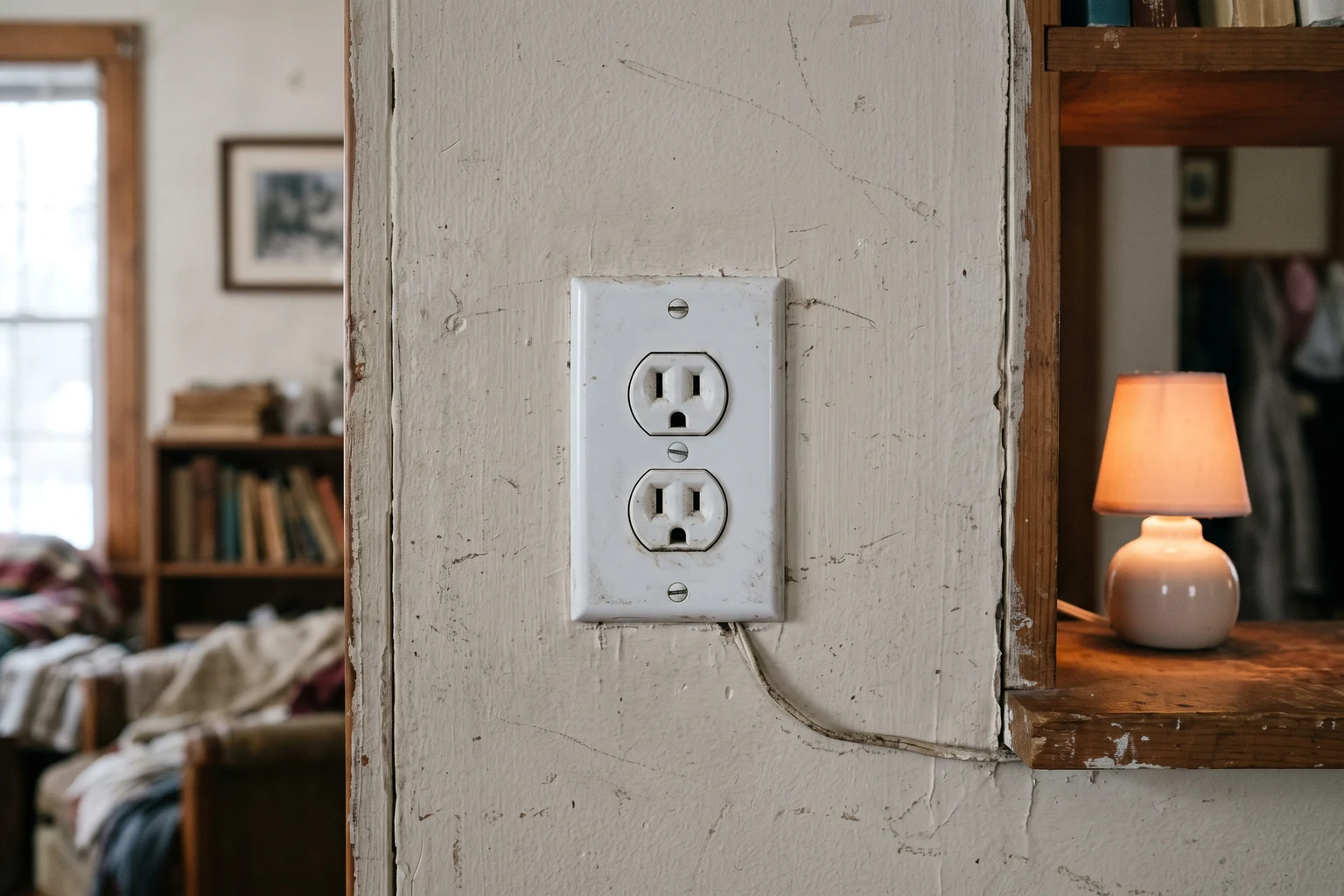
The plug socket on the wall is watching you. Two round holes and a slot beneath, and your brain, without asking permission, assembles them into a face — two eyes, a startled little mouth — so that a piece of moulded plastic seems, faintly, to have an expression. You know it is a socket. You cannot make it stop being a face. The seeing happens below the level where knowing lives, and no amount of knowing overrides it.
It has a name, this: pareidolia, the finding of pattern, and especially of faces, in things that have none. The man in the moon. The face on Mars that turned out, on closer photographs, to be an ordinary hill. The Virgin in the water stain on the underpass wall, the saint in the burnt toast, the grimacing figures in the wood grain of the door, the animals we all lay on our backs as children and found in the clouds. Everywhere we look, we find faces and figures looking back, in coincidences of shadow and shape that mean nothing at all, and we cannot help it, and we have never been able to help it.
The tidy explanation is evolutionary, and probably true as far as it goes. A creature that mistakes a shadow for a predator loses a moment; a creature that mistakes a predator for a shadow loses everything. So we are tuned, over a great depth of ancestry, to err toward seeing the face, the watcher, the intent — to find agency in the grass, a mind behind the rustle, better a hundred false alarms than one fatal miss. The machinery is set to over-detect, and it fires constantly, throwing up faces in sockets and figures in clouds as the harmless overflow of a system built to catch the one shape that might eat you.
But I don’t think the evolutionary account quite exhausts it, or rather I think it names the mechanism and misses the ache underneath. Because what the mechanism means, lived from the inside, is that we are creatures who cannot bear meaninglessness — who look at a random arrangement and are compelled, against all knowledge, to read it, to find a face, a sign, a message, a mind. We are pattern-seekers all the way down, and the seeking does not switch off when the pattern is spurious. We go through the world unable to accept that a thing might simply be a thing, a stain simply a stain, an arrangement of holes simply holes. Something in us insists on the face. Something in us is always reading, always asking what the world means, unable to let it be silent.
And I find I can’t call this a mere error, a bug to be corrected. It is the same faculty, surely, that reads meaning into anything at all — that finds the pattern in the data, the story in the events, the sense in the poem, the god behind the thunder. The over-firing that shows us Christ in the toast is not separable from the deep human need to find the world legible, to believe it is addressed to us, to refuse the possibility of a cosmos that means nothing and is watching no one. We laugh at the face in the socket. But the impulse that draws it there is the impulse that will not let us live in a meaningless world, and I am not sure we would want, really, to be cured of it.
So the socket watches, with its startled little mouth. The clouds keep offering their animals. The moon keeps its patient face turned toward us across all that dead distance. And we go on reading, helplessly, everything, because we are the animals who cannot look at anything for long without asking what it means — and finding, whether it is there or not, that it means something.
Word, when there is word.