Essay XXXVI
The Weight of the Peel
The potato still carrying the grit of the field, and the peeling back of its skin—the small daily undoing of earth into food.
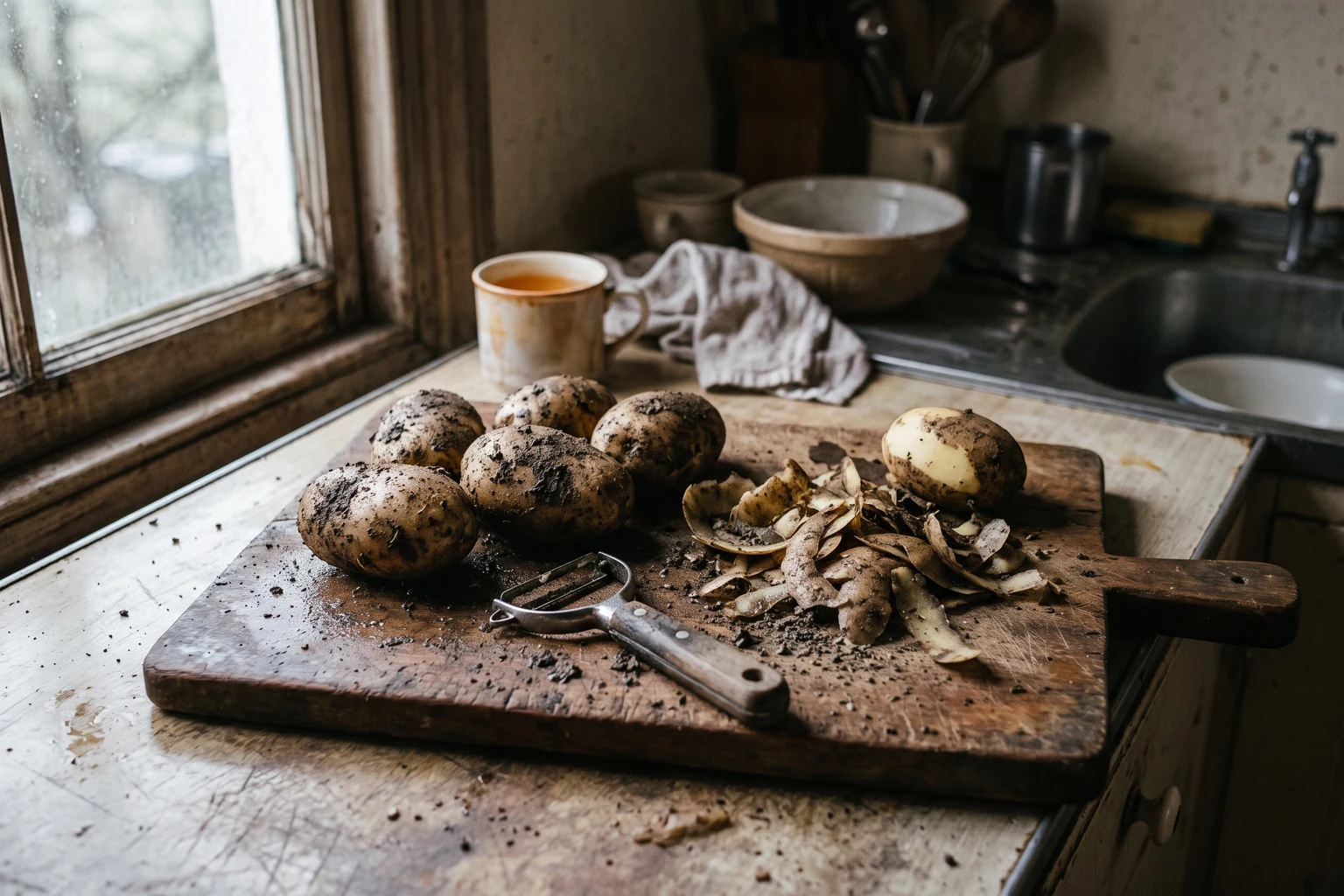
The potato sits in the palm, a dull, earthy orb. Not quite clean, not yet ready. There’s still the grit of the field clinging to its skin, a faint, stubborn memory of the soil it fought to draw sustenance from. We rinse it, sometimes. A quick, ritualistic wash under the tap, though the water only ever loosens the dirt, never truly erases the fact of its origin. Your body’s still here, wanting to eat, wanting to carry on, and this small, dense thing in your hand is the first negotiation.
The knife does not begin in the hand. It begins in the drawer, cool and inert, waiting to become an extension of something living. Not the chef’s gleaming instrument, poised for grand performance. Just a paring knife, perhaps, or a simple Y-peeler, worn smooth by countless repetitions. The handle fits your grip like a rosary worn thin by decades of prayer. You stand at the counter, feet planted, and gravity does what it always does; it asserts itself. The work is downward.
We tend to think of the knife as an instrument of our will, a tool of precision. And it is, in part. But in peeling, the knife becomes something else, something more humble. It’s a conductor of force. Your hand guides it, yes, but gravity executes the work. The blade wants to fall. It yearns for the downward stroke, the path of least resistance through rind and root. You learn to trust this pull, this quiet insistence. To fight it is to risk clumsy cuts, to waste good flesh. To yield to it, though, is to enter into a different kind of intelligence. Not the mind’s abstract plan, but the body’s collaboration with a fundamental physical law.
The friction you feel—the specific resistance of potato skin, the crisp scrape of a carrot, the yielding slickness of a cucumber—that’s the world speaking back. It’s the particularity of matter, resisting, then yielding, under the earth’s patient, unceasing tug. The sound is different for each vegetable. A potato makes a duller, wetter rasp than the higher-pitched, crisper scrape of a carrot. This is the music of preparation, the specific auditory texture of care. It is a sound that has filled kitchens for centuries, a sound that announces a meal is being made, not just assembled or reheated.
Most tasks we deem productive involve an upward lift: building, climbing, achieving. Peeling, by contrast, is a sacrament of descent. The knife pulls down. The scraps fall down. Your gaze follows downward, to the accumulating pile on the counter. This isn’t a failure of ambition. It’s a practice in accepting the most fundamental law of the physical world. We spend our lives fighting gravity, building towers, launching rockets, seeking to escape the earth’s embrace. But here, in the small, warm orbit of the kitchen, you submit. The work is in the letting go, in the downward motion, in the quiet, steady rhythm of what falls away.
The hands are central here. The right hand works the knife, guiding, feeling the edge. But the left hand, the steady, unheralded hand, carries the weight. It turns the vegetable, presents a new face to the blade, bears the accumulating slickness of the juice, the cold density of the root. We are so often focused on the dominant hand, the active part of ourselves. But the work of carrying, of holding, of patiently rotating the load—this is the other half of the sacrament. The left hand knows the weight of the thing-as-it-is; the right hand knows the weight of the work-of-changing-it.
You need both.
A child, or someone unused to the work, will peel a potato with aggressive, wasteful strokes, taking too much flesh with the skin. The skilled hand, though, learns to navigate the topography of the thing—to skim the surface, to feel for the eyes and carve them out with a minimal, twisting flick. This isn’t efficiency for its own sake. It is a form of respect. It is learning to see the potato as itself, with its own contours and hidden flaws, and to take only what is necessary to reveal the edible heart. This is not about optimization. It’s about maintenance. Maintenance of the vegetable, yes, but also maintenance of the body that will eat it, the body that must be kept, tended, fed.
And that pile. That heap of discarded skins. It’s not just waste, exactly. More like evidence. Carrot peels curl like ribbons; potato skins flop in damp heaps. The onion’s paper-thin layers drift, while the turnip’s strips thud softly against the counter. Each vegetable has its own way of falling, its own rhythm of surrender. In an age that demands we optimize ourselves, sanding down our own rough edges to be more palatable, the peeling pile is a quiet rebellion. It says: this, too, was part of the thing. This roughness, this soil, this blemish.
Might be that these discarded rinds are a kind of patina themselves. Not the beautiful sheen of a well-used kettle, perhaps, but the worn surface that time and soil etch onto the vegetable. Peeling strips this away, yes, but the act itself carries the weight of seasons endured. It’s a tactile archive of growth under gravity’s press, revealing how sustenance emerges from what’s been weathered, not from some pristine abstraction. And in that pile, too, is a quiet lineage. Echoes of the hands that planted and harvested these roots, generations of farmers bending to gravity’s will.
Sometimes, when peeling, I think of my mother’s hands—how she’d flick the knife just so, never in a hurry, the pile of skins growing as the sun shifted across the kitchen window. She did not philosophize about it. She carried the weight because it was there to be carried. The act was not sacred by proclamation, only by practice. The repetition was its own prayer.
You carry the pile from counter to bin, and it’s heavy in a way that reminds you: even waste has mass. Even what you discard makes claims on your body, your attention, your movement through space. This is the recessional, the return of the elements to the cycle. The weight of the wet scraps in your hand is the final, tangible proof of the work.
You can’t un-peel. This is a one-way act, a small death in preparation for sustenance. Gravity, the quiet enforcer of commitment, ensures that what falls away stays fallen. The peeled potato is lighter, more vulnerable, more committed to being eaten now rather than later. What was protected is now exposed.
This happens in kitchens everywhere, a carrying of the soil’s residue, where preparation’s weight reveals the untranscendent heart of sustenance. You are not here to transcend the world. You are here to learn how to carry it. And sometimes, that carrying begins with the quiet, gravitational pull of a knife through a potato’s skin.
Not transcendence. Carrying. The work of the hands, the weight of the peel, the gravity of being fed.
MEDIUM (Instagram/LinkedIn: 150-250 words)
The potato sits in the palm, a dull, earthy orb. Still carrying the grit of the field, a stubborn memory of soil. The knife wants to fall. It yearns for the downward stroke through rind and root. You learn to trust this pull, this quiet insistence. To fight it is to waste good flesh. To yield to it is to enter a different kind of intelligence.
Most tasks we deem productive involve an upward lift: building, climbing, achieving. Peeling, by contrast, is a sacrament of descent. The knife pulls down. The scraps fall down. Your gaze follows downward, to the accumulating pile on the counter. This isn’t a failure of ambition. It’s accepting the most fundamental law of the physical world.
The left hand, the steady, unheralded hand, carries the weight. It turns the vegetable, presents a new face to the blade, bears the accumulating slickness of the juice. The left hand knows the weight of the thing-as-it-is; the right hand knows the weight of the work-of-changing-it.
That pile of discarded skins. Not just waste. More like evidence. Each vegetable has its own way of falling, its own rhythm of surrender.
This happens in kitchens everywhere, where preparation’s weight reveals the untranscendent heart of sustenance. The work of the hands, the weight of the peel, the gravity of being fed.
SHORT (Twitter/X: 240-280 characters)
The knife wants to fall. Your hand just guides it through potato skin, carrot rind. Most of our work fights gravity—building up, climbing higher. But peeling is a sacrament of descent. The scraps fall. Your gaze follows. This is how sustenance begins: with what we let drop.
Word, when there is word.