Essay XXXVIII
Learning Your Actual Reach
Reaching sock-footed for the favoured mug on the top shelf, and learning the true, humbling length of your own arm.
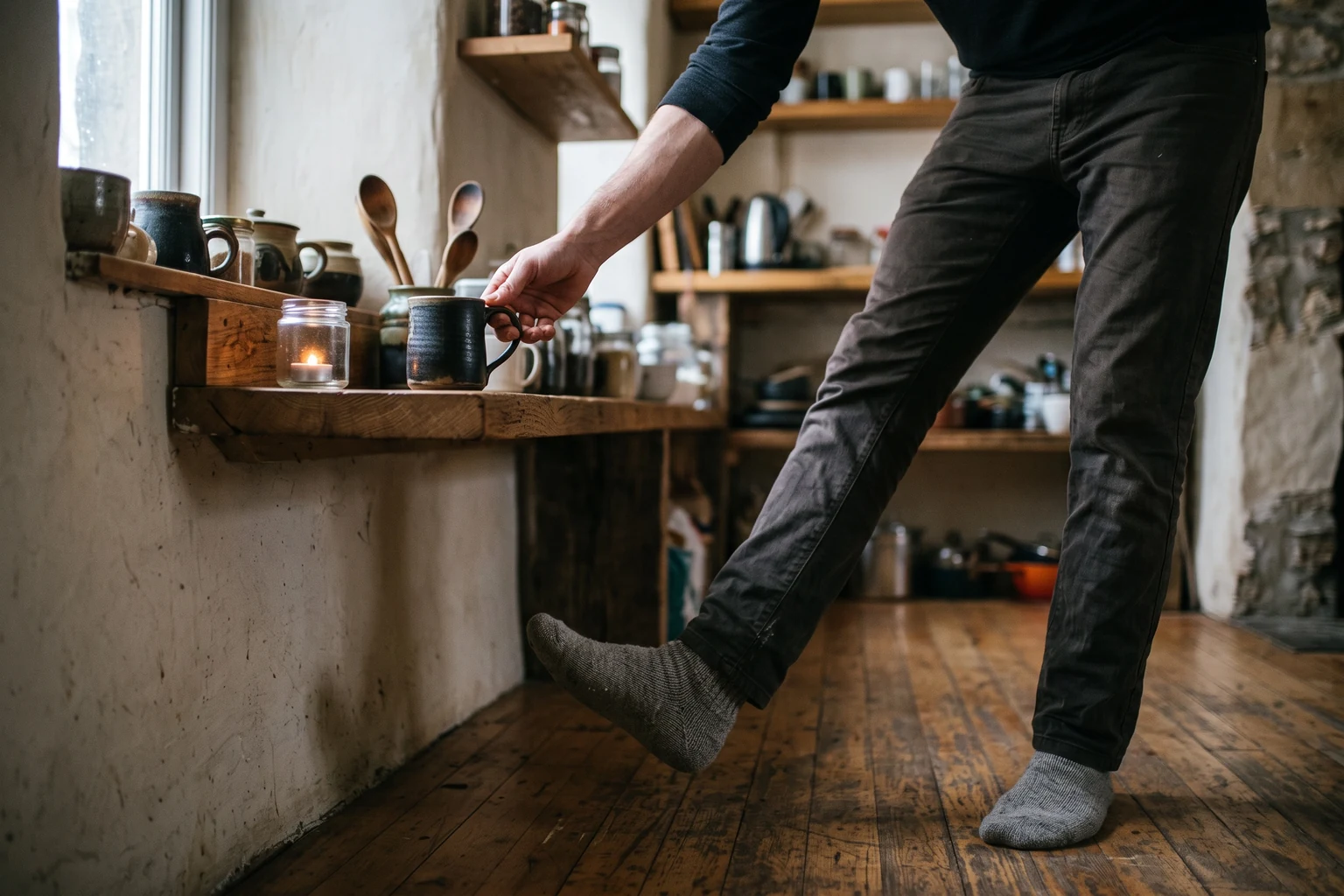
You only discover the true length of your arm when you’re standing, sock-footed, in front of the cupboard, reaching for the chipped mug on the top shelf. The one you favour, though you wouldn’t say why. You stretch. Fingers splayed, shoulder straining, the cold edge of the countertop pressing into your thigh. You think, “I can get it.” Sometimes you do. Sometimes you don’t. The difference is smaller than the thickness of your thumbnail.
The mind is a poor cartographer of the body’s frontiers. You remember being taller, or at least more limber. You remember the days when reaching the top shelf was a matter of course, not a calculated risk. The body, when trusted, is honest; the mind, left to itself, is a fantasist.
This is what happens when you live mostly in your head: you begin to believe your reach extends further than your arm allows. You measure by convenience, by impatience, by the faint embarrassment of needing a stepladder. You don’t measure by the grain of the wood beneath your palm, or by the ache in your shoulder the next morning.
The men I knew growing up—men who carried hods of brick, men who knew the heft of a shovel and the treachery of a wet ladder—rarely overestimated their reach. They learned early that the body’s limits aren’t suggestions; they’re facts. Ignore them and you pay, in bruises and broken crockery. A carpenter doesn’t guess whether the board will reach; he measures. That yellow steel tape, sprung from its case with a familiar whisper, locked into place with a click. The ritual isn’t a lack of confidence. It’s respect. Respect for the material, respect for the task, respect for the undeniable fact that his body, for all its experience, can still be off by an inch and a half.
There’s a particular liturgy to these misjudged stretches. The little hop, the balancing on tiptoe, the way you convince yourself, just for a moment, that you’re taller than you were yesterday. And the quiet, almost shameful, admission when you aren’t. You fetch the stool. The confession of defeat is silent, but the body remembers.
It’s not only shelves. The same drama plays out with grocery bags—how many you can carry in one trip from the car, the red grooves the handles carve into your fingers. Or with the stubborn jar lid, gripped and twisted with too much confidence, then passed—reluctantly—to someone with stronger hands or better leverage. The walk from the car to the kitchen becomes a lesson in your actual capacity. Not your aspirational capacity, not your impatient capacity, but the real, tensile strength of your tendons and the balance of your frame.
The thing is, though, the world keeps changing even as you’re learning its dimensions. You move house and reach for the light switch in the old place. Your hand hovers in midair, grasping at memory. Or you wake one morning and discover your shoulder doesn’t rise as high as it used to. The map needs constant redrawing. The body, if you listen, tells you when to stop. The mind, distracted by nostalgia or pride, often doesn’t hear.
Consider the house in the dark. In a blackout, or in the deep hours of the night, you don’t think about where to walk. Your body knows. It knows the third step from the top groans under pressure, knows the precise arc to swing the bathroom door to avoid the click of the latch. This is spatial knowledge earned through friction, through small, nocturnal corrections, through the occasional stubbed toe. The mind would draw a straight line. The body knows the necessary detour.
There’s a kind of grief in this—grief for what you could once reach, for the confidence that belonged to youth or habit. But there’s also something like grace. When you accept the shape of your own span, you begin to work with the world, not against it. You fetch the stool before you strain. You take two trips with the shopping. You ask for help, and discover—quietly, awkwardly—that this too is a form of reach, extended through another’s hands.
Rock climbers speak of “wingspan”—the measured, honest distance from fingertip to fingertip. They train not to extend it, but to know it exactly. Every movement calculated, every hold chosen with humility. Perhaps that’s a kind of liturgy, too: learning your own dimensions, moving within them, accepting that what lies beyond is not for you. At least not today.
The stepladder sits in the garage, perfectly capable. To fetch it, to unfold it, to climb it, feels like a small surrender. An admission that the body, your body, is not quite what you imagined it to be. And yet, this is the very lesson. Knowing your reach isn’t about limiting yourself; it’s about understanding the weight of what you can carry.
There’s a shadow to reach, too. Overreach. The man who thinks he can mend everything, hold everyone together, carry every sorrow. The body, if ignored, will remind him. Most things break not from being touched, but from being seized too firmly, too far.
The mug returns to its place. The bruise on your shin fades. The body remembers. You learn to live at the edge of your span, sometimes stretching, sometimes retreating. Maintenance, not mastery. Carrying what you can, letting the rest wait.
You are not here to transcend the world. You are here to learn how to carry it. One shelf at a time. One reach—honest, tentative, incomplete—after another.
MEDIUM (Instagram/LinkedIn)
The thing is, though, you never really know the distance until your fingers brush the edge of it. Not the edge of the shelf—the edge of your own assumption.
I’ve seen this. A man standing in his kitchen, arm stretched, shoulder straining, that little hop you do when you’re sure you’re just an inch short. Not a full jump, just that slight lift, as if gravity itself might be fooled. It never is. The jar stays where it is.
Men who work with their hands learn this early. They measure twice, not because they doubt themselves, but because they respect the material. Wood doesn’t lie. Neither does metal, or the weight of a grocery bag. A carpenter pulls out the tape—that yellow steel, sprung from its case with a familiar whisper. The ritual isn’t a lack of confidence. It’s respect for the undeniable fact that his body, for all its experience, can still be off by an inch and a half.
The stepladder sits in the garage, perfectly capable. To fetch it feels like a small surrender. An admission that the body is not quite what you imagined it to be. And yet, this is the very lesson. Knowing your reach isn’t about limiting yourself; it’s about understanding the weight of what you can carry.
Your body’s still here, wanting. But it wants honestly. The truth of your own reach. Not more, not less. Just what is.
SHORT (Twitter/X)
The mug on the top shelf. You think you can reach. Your fingertips brush the handle, but there’s no purchase. The body knows what the mind forgets.
Word, when there is word.