Essay XLI
The Service Station at Three in the Morning
A motorway services at three in the morning—hospital light, no one you know, a non-place between places—and who you are when you stop there.
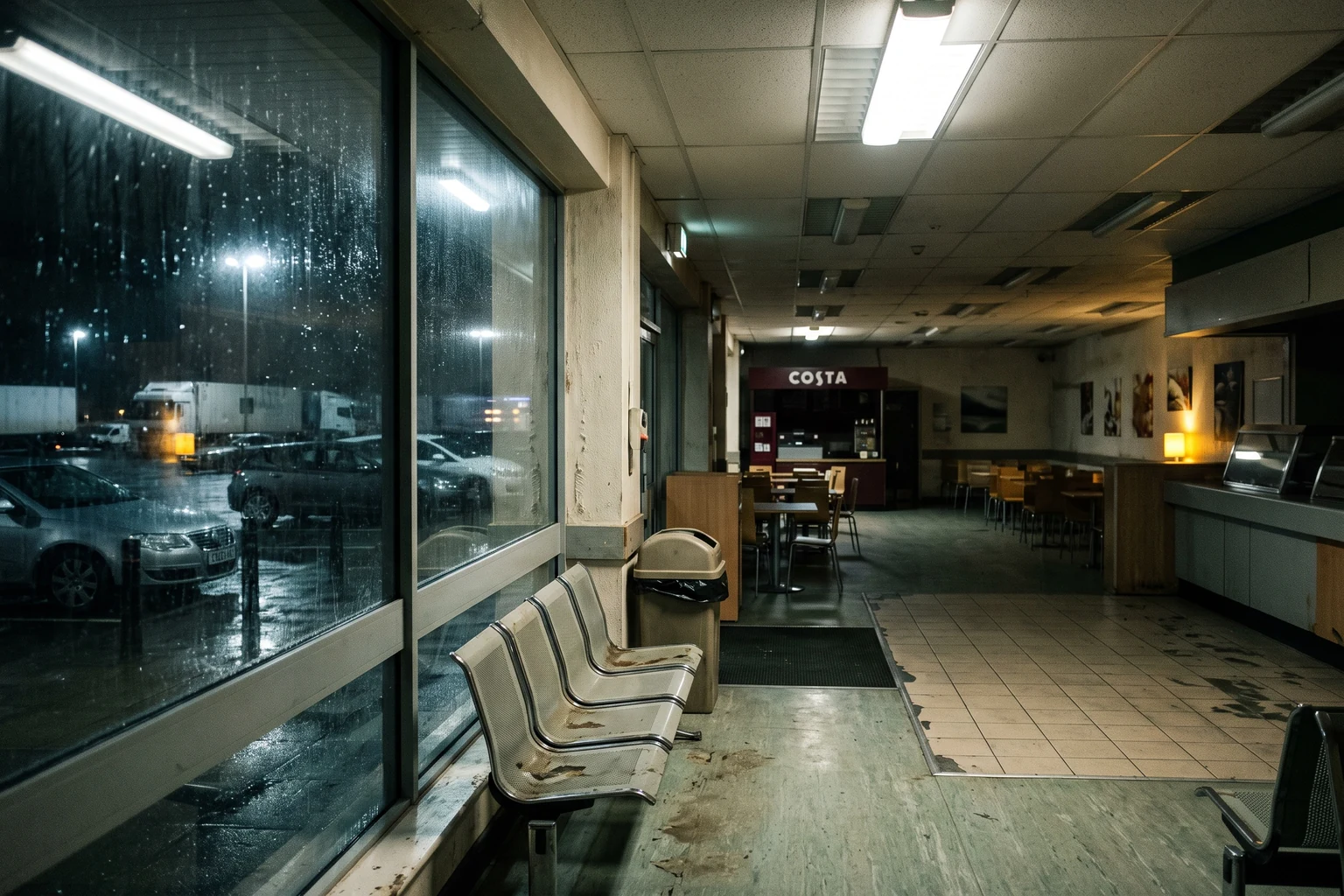
There is nowhere quite like a motorway services in the small hours. You pull in off the dark road because your eyes are going or your bladder is full or you simply cannot drive another mile without standing up, and you step out of the car into a car park lit the colour of a hospital, and you walk toward the low glowing box of the building, and the automatic doors part for you, and you are — nowhere. Precisely nowhere. A place built for no one to be, only to pass through, kept alight and staffed and open at an hour when the whole point of it is that you will not stay.
Inside, the lights are merciless and even, the same everywhere, casting no shadow and no time. The coffee machine hisses to itself. A fruit machine cycles its colours in a corner, playing its little tune to nobody. There is a smell of fried things held too long under lamps, and floor cleaner, and the faint sweetness of the sweet racks by the till. A lorry driver sits alone with a mug, staring at nothing. A family drifts through, the children grey-faced and silent with tiredness, the parents moving on instinct. Nobody meets anyone’s eye. Everyone here is from somewhere else and going somewhere else, and this is merely the gap in between made briefly physical, a room you occupy for eleven minutes and forget completely by the next junction.
It is outside of time in a way few places manage. Three in the morning has no business being lit like noon, and yet here it is, the same brightness, the same music, the same racks of the same crisps, a permanent artificial daytime maintained against the dark for the benefit of people who are only ever half-awake and never local. You could be anywhere on the network. They are built to be interchangeable, and the interchangeability is the strange comfort and the strange desolation of them both at once — you know exactly where the toilets will be, exactly what the coffee will taste of, exactly how much they will charge you for it, in a building you have never entered before and will not recognise if you pass it in daylight.
I find them oddly moving, these places, though I would not want to spend an hour in one. There is something almost sacred in a space kept open purely to receive people in transit — a lit room in the middle of the night’s long emptiness, offering warmth and a toilet and a hot drink to whoever the road delivers, asking nothing but that they move on. A cathedral of transit, if you like, except that no one who enters means to worship, or lingers, or thinks of it again. They come in cold and blinking, they use the place, they leave. And it stays lit for the next ones, and the next, all night, every night, a permanent brightness held up against the dark for a congregation that never gathers and never stays.
You buy the coffee. You use the toilet with its industrial everything and its notice about who last checked it. You stand a moment by the doors looking out at the black car park and the red lights streaming past on the motorway beyond, everyone going somewhere, no one here from here. Then you go back to the car, and pull out, and the glowing box shrinks in the mirror and is gone, still lit, still open, still waiting, in the middle of nowhere, for whoever comes next.
Word, when there is word.