Essay LIV
The Almost-Face
The cartoon face we warm to, the almost-human one we recoil from—the narrow valley where a likeness gets close enough to be wrong.
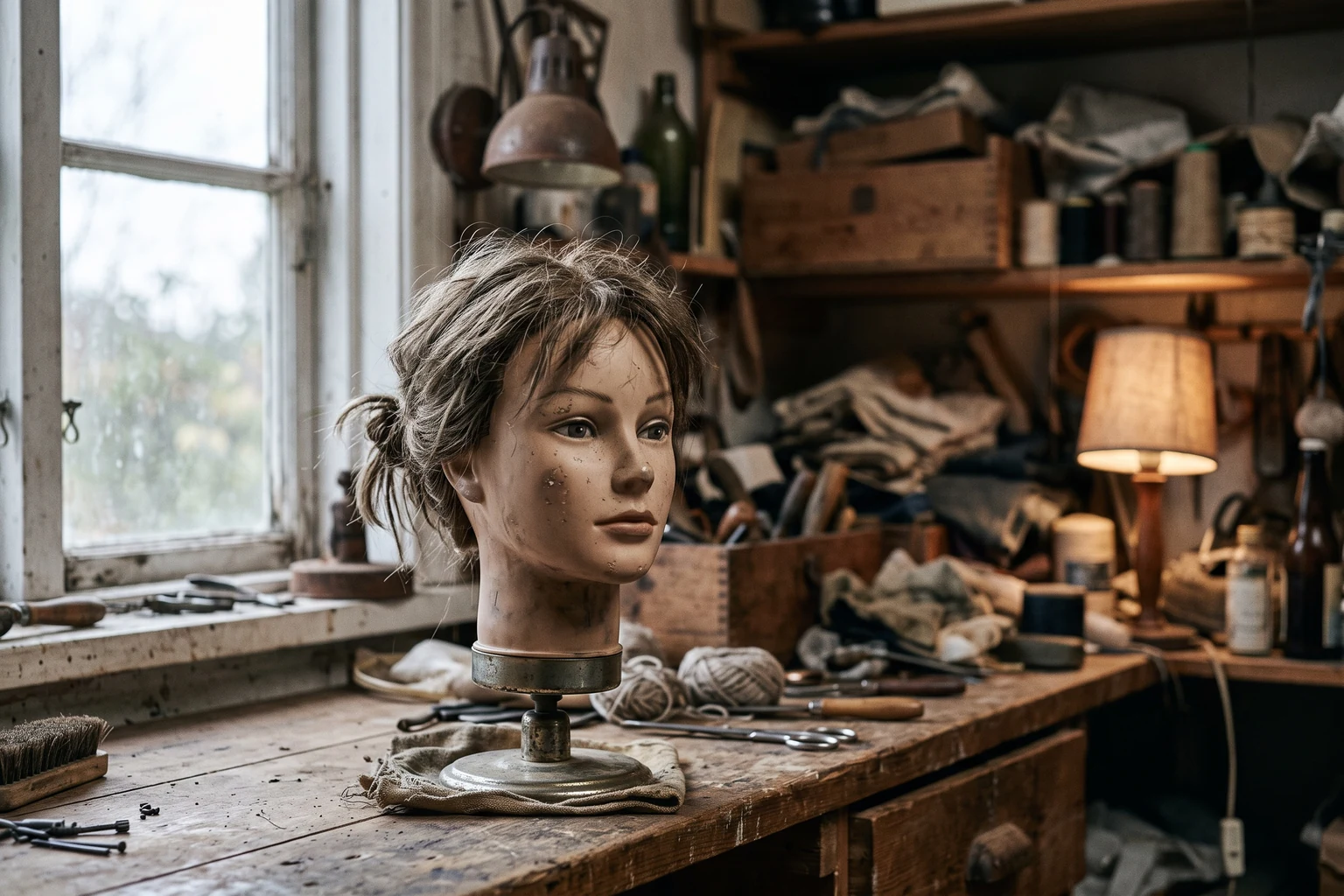
Show a person a cartoon face — two dots and a curve — and they warm to it. Show them a wooden doll, a puppet, a stylised figure, and they are untroubled, even charmed. But show them a face that is almost, but not quite, a real human face — a very lifelike android, a computer-rendered person got to within a hair of real, a waxwork of unusual quality — and something goes wrong. A cold, crawling wrongness rises in them, a revulsion they can’t quite name, a strong wordless wish to look away. The thing is too like us, and not like enough, and the gap between the two is where the horror lives. They call it the uncanny valley: the sudden plunge from charming to repellent that happens right as an imitation of life approaches, but fails to reach, the real thing.
It is a strange and specific alarm, and it is worth taking seriously as information. A less faithful copy does not trigger it — a teddy bear, a stick figure, a mannequin frankly artificial. It is precisely the good fake that disturbs, the one that has removed almost all the friction between fake and real, so that only the last sliver of wrongness remains — a stillness in the eyes, a slight wrongness in the way the mouth moves, a skin that is too even, a blink that comes a beat late. The closer the imitation gets, the more we forgive it nothing, until at the very threshold of success it fills us with dread. We are most repelled by the copy that has almost got away with it.
I notice that I am, in most things, a defender of the smooth and the made — I will take the hand-worn tool, the well-made object, and I am slow to distrust a thing for being crafted. But here my instinct turns hard the other way, and I think it turns rightly. The uncanny valley is the body’s alarm at a particular kind of counterfeit: the counterfeit of life itself. It is one thing to make a smooth surface, a frictionless interface, a convenient machine. It is another to make a smooth person — to manufacture the appearance of a living, feeling, present being and put it in front of us to be mistaken for one. And at that, some old and reliable part of us recoils, and I am glad it does. The revulsion is a guardian. It is the deep self refusing to be fooled about the one thing it most needs to judge truly: whether the face before it is alive, and whether there is anyone home behind the eyes.
We are being asked, more and more, to override that guardian. To speak with voices that are not attached to anyone. To take comfort from faces that were never born and will never die, generated to be pleasing, tuned to hold our attention, imitating warmth without possessing it. The whole drift of the technology is to close the valley — to make the fake so perfect that the alarm stops firing, so that we no longer feel the wrongness, no longer look away, accept the manufactured presence as though a presence were there. And I think the alarm is exactly the thing worth keeping. The crawling unease at the almost-human is not a malfunction to be engineered around. It is a form of knowledge — old, bodily, hard to fool — about the difference between a living thing and a very good picture of one.
So when the wrongness rises, I have learned to trust it rather than to master it. That cold recoil at the almost-face is not squeamishness. It is the last sliver of honest judgment refusing to be smoothed away, the body insisting, against all the polish, that there is a difference between what is alive and what only looks it — and that the difference matters, and that it can still, for now, tell.
Word, when there is word.