Essay IV
Breaking in the Boots
New leather that doesn't want you, and the slow mutual breaking-in by which a boot and a foot learn to belong to each other.
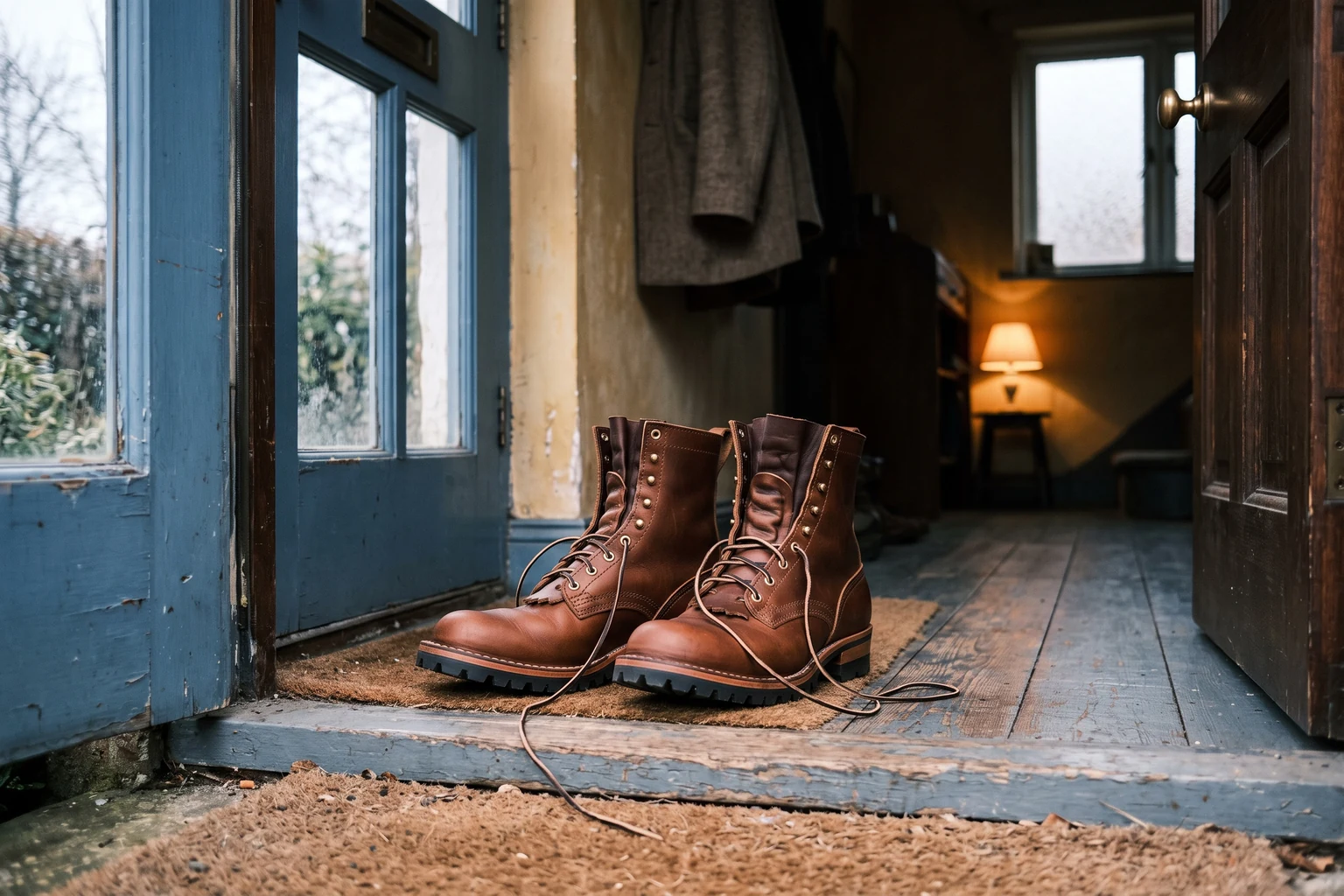
New leather doesn’t want you. You get the boots on — a struggle in itself, the tongue stiff, the heel counter hard as a shell, your foot forcing its way down past a collar that hasn’t learned to open — and you lace them, and stand, and the boots stand around your feet like something built rather than worn. The leather is unyielding. It holds its own shape, a shape decided by a last in a factory, not by you, and your foot is simply a thing that has been inserted into it.
You feel every edge. There’s a hard ridge where the sole meets the upper that presses across the top of your toes. The heel counter grips at the back, rigid, rubbing with each step at exactly the spot where your own heel rises and falls. The leather creaks when you walk — an actual sound, a stiff protesting creak from the bend across the ball of the foot where the boot doesn’t want to flex and your walking makes it flex anyway. It’s like walking in a cast. Everything that will one day be soft is, right now, a hard argument between the shape of the boot and the shape of you.
And then the soreness. This is the toll, and it’s paid in the body. The first long day in new boots and you can feel the rub building — a heat at the back of the heel, a hot spot across the little toe, the friction of stiff leather working against skin that was minding its own business. If you push it, a blister comes up, tight and stinging, right where the counter grips, and you limp the last mile home having learned exactly where the boot and the foot most disagree. The leather is teaching your feet where it is, and your feet are teaching the leather where to give, and the lesson costs.
But leather is not wood. This is the mercy of it, the reason you keep wearing them through the soreness: leather remembers. It’s skin, still, in some slow sense, and it takes an impression and keeps it. Day by day the places that dug in begin to yield. The hard flex across the ball softens where your foot keeps bending it, a crease forming there, then a whole field of fine creases, the leather learning the one fold your stride asks of it. The heel counter, worked at every step, loses a little of its shell and starts to cup your heel instead of fighting it. The collar opens. The tongue lies down. The creak fades.
You can watch the boots change if you look. The uppers, once smooth and blank and identical to every other pair off the shelf, take on the map of your particular feet — a bulge where a knuckle of toe pushes out, a set of creases fanning across the bend, a darkening and softening at the points where your hand grips to pull them on and your foot presses as you walk. They stop being a pair of boots and become yours, shaped to one body and no other, so that another person’s foot would find them subtly wrong, worn to a stranger’s angles.
And one ordinary morning, weeks in, you put them on without thinking about it. No struggle at the collar. No hard edge across the toes. Your foot goes down into a shape that fits it because it made that shape, wore it in over miles of small soreness, and the boot flexes with your step easy and silent, warm, close, creased all over with the record of the breaking-in. The leather gave. Your feet gave. Somewhere in all that rubbing the two of you stopped disagreeing and arrived at a fit — not the one the factory decided, but the one your walking negotiated, one sore day at a time, until the boots forgot they were ever anything but yours.
Word, when there is word.