Essay XLVIII
The Whetstone
Water, stone, and the two-coin angle a hand comes to believe: the patient restoring of an edge.
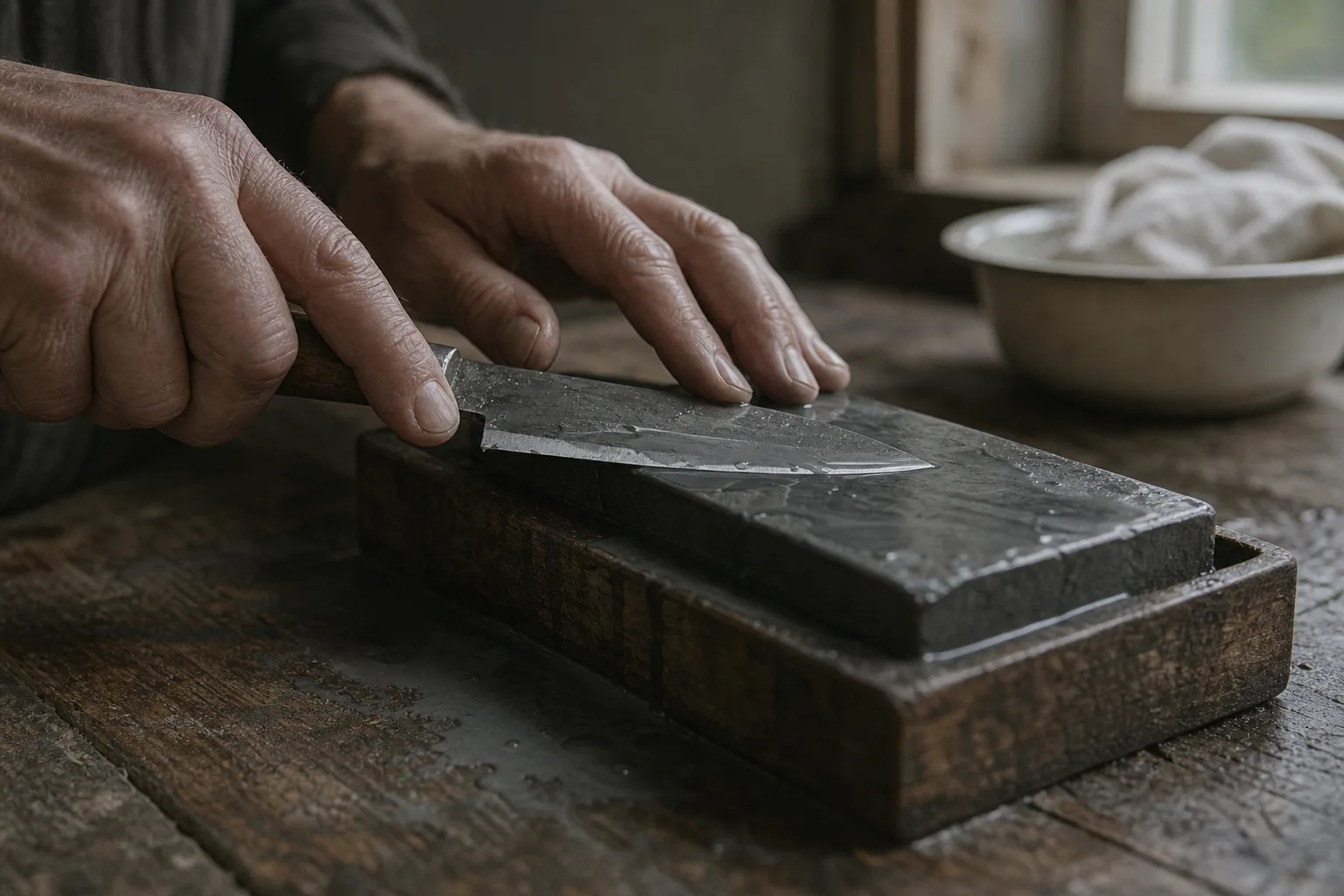
The stone comes out of the drawer heavier than you remember, a grey brick with a slight dish worn into its middle from the years. You run a thumb across the face. Fine grit, close as skin. You set it in its cradle and pour water over it, and for a moment the water just sits there in beads, refusing. Then the stone drinks. The surface darkens from the edges inward, going the colour of wet slate, and a few small bubbles rise and pop where the air is leaving the pores.
You lay the knife down flat and lift the spine a little. Two coins’ thickness, someone once told you, and your hands have believed it ever since. The first pass is almost nothing — a dry, papery whisper as the edge skates across the top of the water. You draw the blade toward you, heel to tip, following the curve so the whole edge takes its turn against the stone.
By the third or fourth pass the water has changed. It’s gone milky, then grey, a thin slurry of stone and steel lifting up out of the surface and gathering at the low end of the dish. This is the part nobody tells you to expect. The slurry is the work. It’s the stone giving up its own grit to do the cutting, and the metal you’re wearing away, mixed together into something that smells faintly of iron and rain on a stone step.
The sound thickens as the slurry builds. What started as a hiss becomes a softer sound, rounder, with a bit of drag in it — the sound of something being taken away, slowly, in an amount too small to see. You settle into the rhythm and your shoulder takes it up, and after a while the counting stops being a thing you decide. The blade goes back and forth. The slurry blackens.
Between passes your thumb finds the bevel. Cool, flat, a little wet, and gritted with the slurry so that it feels rougher than a knife has any right to. You wipe it on your jeans and feel again. There’s a fineness starting there that wasn’t there before, a kind of bite when you drag your thumb across it sideways — never along it, your father’s voice, never along it, that’s how you learn what your thumb looks like on the inside.
You flip the blade and work the other side. The trick is to find the same angle again, and you never quite do, but the hands get close. Same number of strokes. Same lean. The idea is to raise a burr — a hair-thin curl of metal that folds over to the far side of the edge as you grind, so fine you can only feel it by dragging your thumb off the edge and catching the faint snag of it. When the burr runs the whole length, the edge has met itself. You’ve worn the two bevels down until they have nowhere left to go but together.
Then you take the burr off. Lighter strokes now, alternating sides, the pressure of a feather, the water almost clean again. The slurry thins. The sound goes back toward a whisper. You are subtracting the last of what you added.
The test is the old one. You hold a tomato and let the edge rest on the skin under its own weight, and if you’ve done it right the skin parts before you’ve decided to push — the give so sudden it feels like the fruit changed its mind. Or you hold a page up and slice, and it doesn’t tear, it opens, with that quiet zipping sound of a clean cut. Your thumbnail, if you’re the sort who does that: the edge catches and won’t slide, biting a little crescent into the nail instead of skating off it.
You rinse the stone. The grey runs off pink-brown in the sink and swirls and is gone. The face is a shade lighter where you worked it, a little more dished than it was this morning — the stone spends itself too, giving a little of its body every time, wearing hollow in the exact place your hands keep returning to. You dry the blade and hold it up. It doesn’t gleam any brighter than before. The sharpness is invisible. It lives in a few thousandths of an inch you’ll never see, only feel, the next time the knife falls through an onion like the onion was waiting for it.
The stone goes back in the drawer, damp, smelling of iron. Your hands smell of it too, and will until you wash them, and a little after.
Word, when there is word.