Essay V
The Burnt Pot
The scorch welded black to the bottom of the pan, the smell that came too late, and the patient soak and scrape that brings it back.
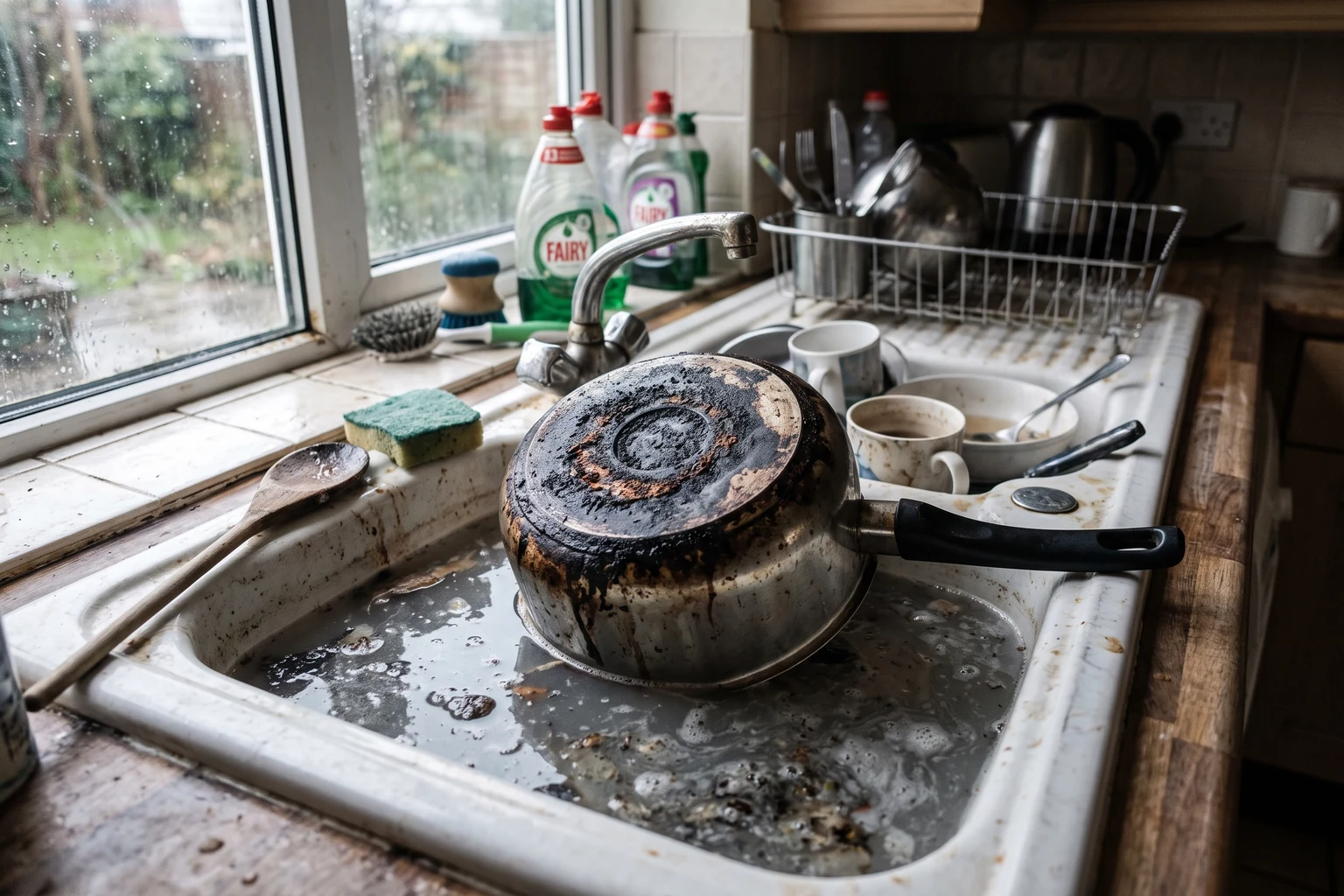
You knew before you looked. There’s a smell that arrives too late to help — the good smell of onions or milk or rice gone over into something scorched and flat and slightly bitter, catching at the back of the throat. By the time you lift the lid the damage is done. The bottom of the pot is welded with it: a black continent with brown coastlines, the char fused to the metal, the last of whatever it was turned to carbon and stuck fast.
The first instinct is to attack it. Everyone has it. Hot water and the scourer and the full weight of the shoulder, scrubbing at the black in hard fast circles — and it does nothing. Worse than nothing. The scourer skates over the surface, taking off a little grey dust and none of the black, screeching against the metal, and after two minutes of it your wrist aches and the pot looks exactly the same and you’ve scratched a bright swirl into the good steel around the burn where the char didn’t even reach.
Force is the wrong tool. You learn this at the sink the same way you learn it everywhere. So you stop, and you fill the pot with hot water instead — enough to cover the black — and you leave it. Walk away. Do something else. The burn isn’t going anywhere, and neither, for a while, are you.
This is the part that can’t be hurried, and it’s mostly waiting. The water sits and works, creeping into the seam where the char meets the metal, softening what was hard, loosening a bond that no amount of your effort could break by force. An hour. Two. Overnight if it’s bad, a little washing soda in the water to help it along, the whole thing sitting on the side going quietly grey and unlovely while the real work happens with nobody watching.
When you come back the water has changed. There’s a slick to it, a few black flakes drifting loose, and when you tip it out they come away and the surface of the burn has gone from glassy-hard to something duller, something with give. Now the scraping means something. You take a wooden spoon, or the edge of a spatula, and you push at the char, and this time it moves — comes up not in dust but in sheets, in soft black scabs that lift and curl away from the metal and reveal, underneath, a patch of dull clean steel that hasn’t seen light since dinner. There’s a real pleasure in it, low and physical: the drag and release, the black peeling back, the growing island of clean.
Not all of it goes. There’s always a ring, or a few stubborn islands welded harder than the rest, right where the heat was fiercest. Those you soak again. You don’t gouge at them — gouging just scores the pot and leaves the black sitting proud in the scratches, harder to shift next time. You wet them, wait them out a second time, and take them up gently, and if a shadow of the burn stays behind, a faint brown ghost of a stain in the grain of the metal, you leave it. It’ll cook out or it won’t. The pot works either way.
The smell changes as you clear it — the scorched note thinning, the ordinary smell of wet metal and dish soap coming back, the kitchen returning to itself. Your fingers are black to the second knuckle. There’s grit under your nails and a grey tide-line around the sink. You rinse the pot and hold it to the window and the steel throws back the light, clean but not new — there’s the faint scratch-swirl from your first impatient minute, there’s the ghost-ring you couldn’t lift, a record of one evening’s inattention written into the bottom where only you will ever see it.
The whole thing took a morning, most of it spent doing nothing, waiting on water and time to do what your arm couldn’t. That’s the lesson the pot keeps teaching, the one you keep having to learn: that the black won’t be scrubbed off by wanting it gone, that some things lift only after they’ve been left to soften, and that the hard part, mostly, is being willing to walk away and let the soaking do what the scrubbing never could.
Word, when there is word.