Essay VII
Seasoning the Pan
Raw grey iron that would rust by morning if left wet, and the black patina seasoned into it, layer by slow layer, by use.
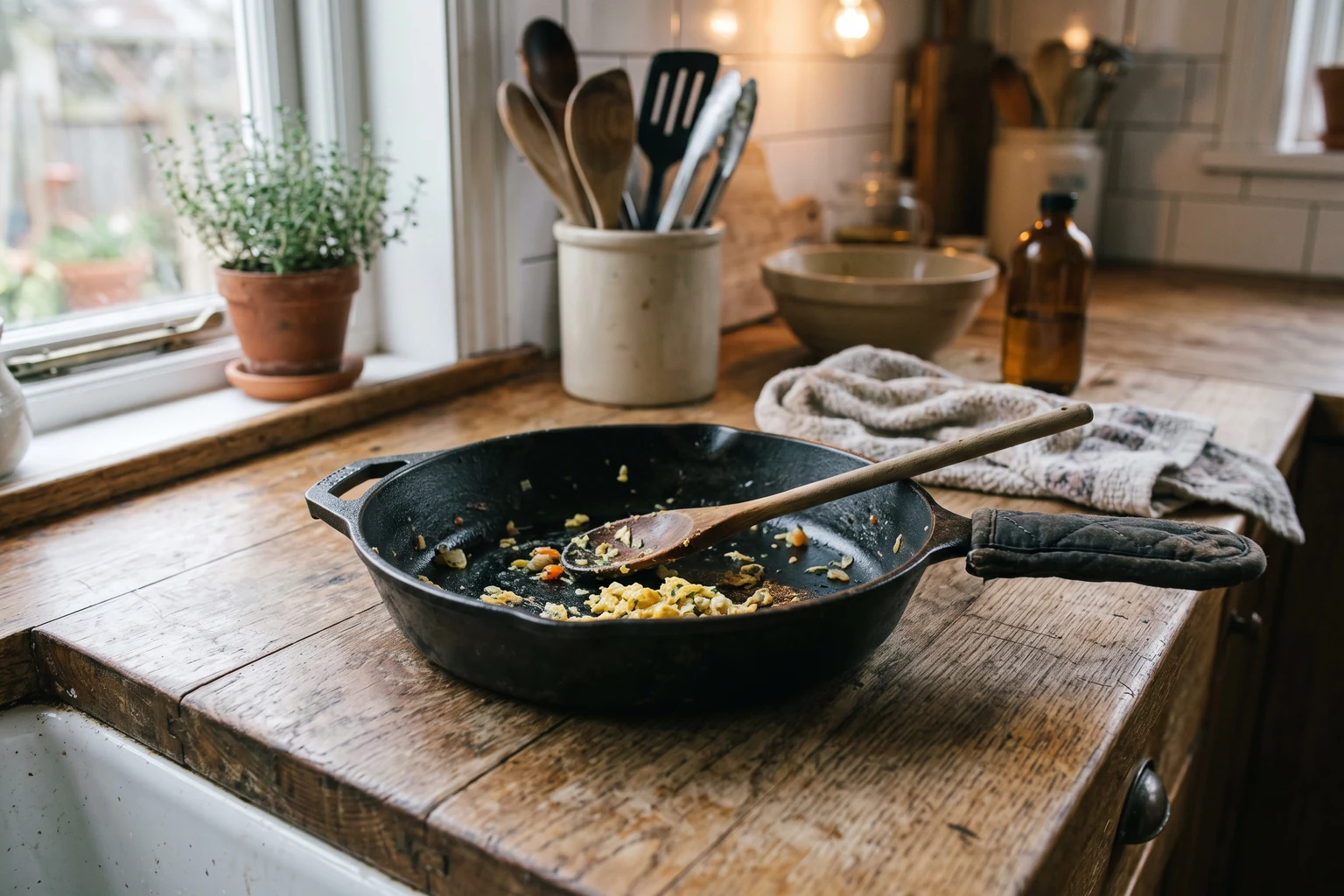
The pan is naked when you buy it, or when you’ve stripped it back — a dull, pewter-grey, the iron showing its grain like the end of a cut log. Raw cast iron feels dry under the fingers, almost chalky, and it will take a fingerprint and hold it as a bloom of rust by morning if you leave it wet. You don’t leave it wet. You warm it on the hob until the last of the rinse-water hisses off and the metal is too hot to hold, and the surface goes from grey to a faint straw colour, the first breath of heat changing it.
Then the oil. A teaspoon, less, poured into the hot pan where it thins instantly and races to the low spots. You take a rag and push it around — into the corners, up the sloping sides, over the handle and the underside and the little casting seam nobody sees. Then, and this is the part that feels wrong the first time, you wipe it all back off again. Wipe until the rag comes away almost clean, until the pan looks dry, until you’re sure there’s nothing there. Whatever you can see is too much. The layer you want is the layer you can’t.
Into the oven, upside down, hotter than you’d cook anything. And you wait, and the smell begins.
It’s not the smell of frying. It’s higher, sharper, a little acrid — the smell of oil going past cooking and into changing, breaking its bonds and finding new ones, laying itself down onto the iron as something that is no longer oil at all. The kitchen fills with it. It gets into the tea towels. Somewhere in that hour the invisible film on the metal stops being a liquid smeared on a surface and becomes part of the surface, bonded, black, yours.
You take it out and it has darkened by a shade. Only a shade. That’s the whole thing you get for an hour — the difference between straw and bronze, bronze and brown. So you do it again. And again. Each round lays down another skin, each one darkening the last, and the colour deepens the way tea deepens, the way a tan deepens, one patient layer at a time until the grey is buried under something the colour of a chestnut, then something the colour of strong coffee, then black. A gloss you built out of nothing but heat and the thinnest possible film of fat, repeated.
You run your hand over it now and it’s changed entirely. Smooth, faintly slick even when dry, warm to the touch in a way the raw iron never was. There’s a depth to the black — not paint-flat but layered, with a slight sheen that shifts when you turn it under the light. You can read the rounds in it if you know how to look, the way you can read a candle by its drips.
The first thing you cook in it is an egg, because the egg is the test and the reward. You get the pan hot, a knob of butter goes in foaming, and you slide the egg down the side. The white sets at the edges and lifts — actually lifts, sliding when you tilt the pan, gliding across the black like the pan is refusing to hold onto it. Nothing you did with a coating out of a bottle ever felt like this. The pan you made non-stick by feeding it, over and over, is releasing what you cook the way a well-worn thing releases everything, having learned the trick of not holding on.
And it can be undone. This is the part that keeps you attentive. Leave it soaking in the sink overnight and you’ll find the water gone grey and a dullness spreading across the black like frost, the seasoning lifting in a fine flaking where the water crept under. Scour it with something harsh and you’ll take back three months in thirty seconds, the black coming away on the pad and the grey iron surfacing underneath like a wound. So you don’t. You wipe it hot with a rag, a little coarse salt if something stuck, a rinse and straight back onto the flame to dry, and then — always — the smallest smear of oil, wiped almost all the way off, while the metal’s still warm enough to drink it.
That last wipe is the whole relationship. Every time you cook, you feed it a little back. The pan gets blacker and slicker the more you use it, which is the opposite of nearly everything else you own, all of which is wearing out even now, in the drawer, in the dark. This one thing gets better by being used, and worse by being spared. You put it away warm and faintly gleaming, smelling of oil and heat, and it holds that smell, low and clean, until the next time you set it on the fire.
Word, when there is word.