Essay VIII
The Bells Working Their Changes
A tower of bells working their changes—living mathematics rung by hand, the same peal never twice, order made audible over a town.
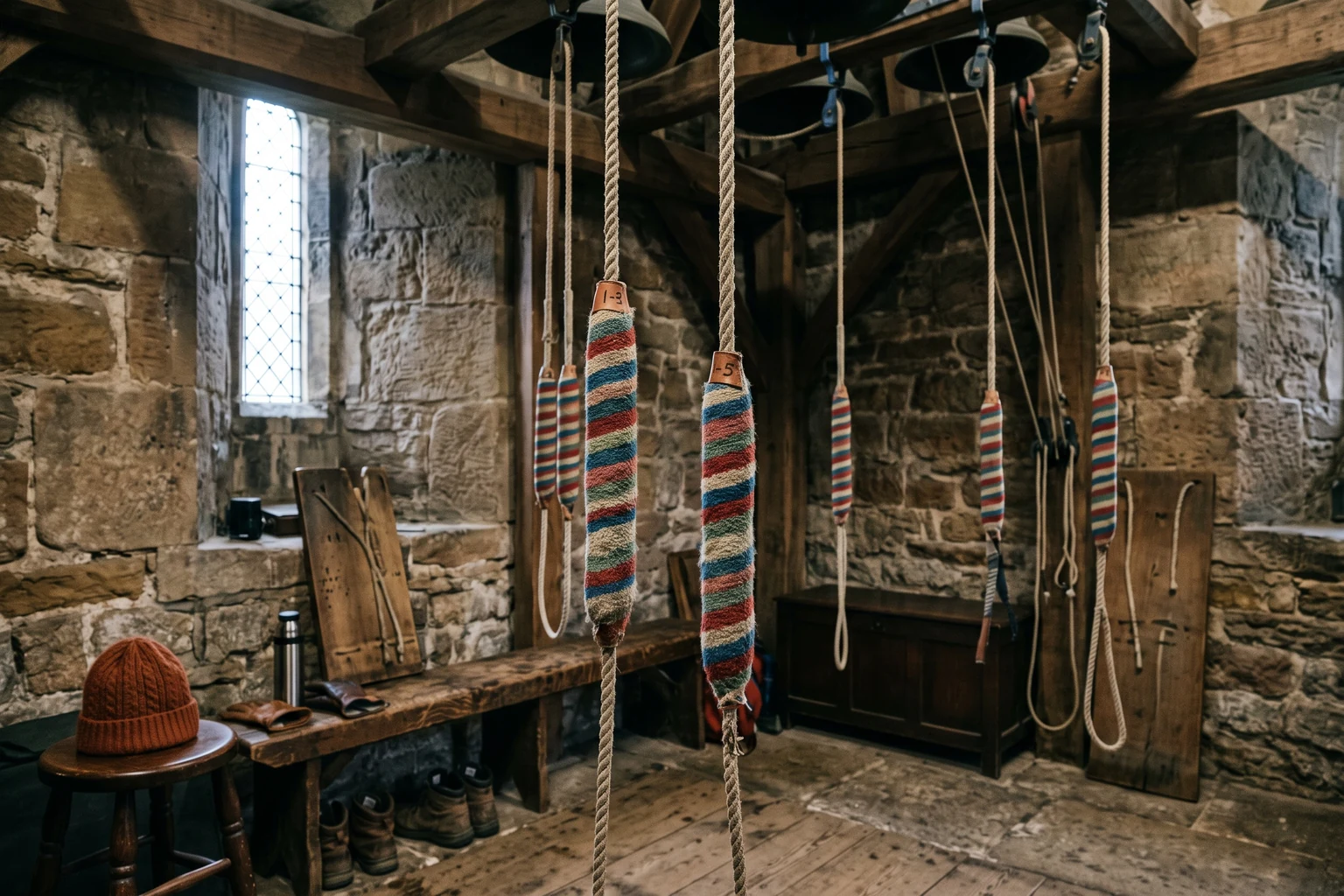
On a Sunday morning, or a practice night in the week, the bells of an English church do something that sounds, to the passing ear, like joyful noise and is in fact a piece of living mathematics being worked out by hand. A band of ringers stands in a circle in the tower below, each holding the rope of one great bell, and they are not playing a tune. There is no tune. What they are doing is ringing the bells in every possible order, one order after another, changing the sequence by strict rules, working their way through a vast permutation of the same handful of notes without ever repeating a single row.
This is change ringing, and it is unlike almost anything else people do. With six bells there are seven hundred and twenty possible orders; with eight, over forty thousand; and a band may set out to ring thousands of these changes in succession, for hours, without pause and without written music, each ringer knowing only the rule for how their own bell moves — up one place in the order, or down one, at each pull — so that the whole shifting pattern emerges from every person following a simple law at exactly the right instant. No one is in charge of the melody, because there is no melody. There is only the method, and each ringer’s faithful execution of their small part of it, and out of that discipline comes the wheeling, tumbling, never-quite-repeating cascade of sound that fills the valley.
And here is the part that undoes me: no single ringer can hear the thing they are making. Each is concentrating utterly on their own bell — on the heavy rope, the great wheel turning far above, the precise moment to pull so their bell strikes in its ordained place — and the overall pattern, the beautiful mathematical whole, exists only in the air outside the tower, only for the listener in the churchyard or the fields beyond. The people making the music cannot stand back and hear it. They are inside it, each responsible for one thread, trusting that if every thread is true the pattern will be there, whole and turning, for someone else to receive.
It is also, by any modern accounting, useless. It produces nothing. It sells nothing, saves no time, solves no problem. It takes years to learn — the handling of a bell alone, the sheer physical mastery of a swinging half-ton of bronze on a rope that can lift a grown man off his feet, is the work of many months before you ring a single change with the band. And then the reward is to stand in a cold tower for three hours pulling a rope in a strict order you have committed to memory, making a pattern you cannot hear, alongside a handful of others doing the same, for no payment and no product and no reason but that the thing is worth doing and has been done in these towers for four hundred years.
That is exactly why I love it. It is a whole discipline built to reward patience and offer nothing the age values — communal, demanding, ancient, and gloriously without point. A village’s worth of people give up their evenings to learn an intricate physical mathematics whose only output is a beauty they must be outside of to perceive, kept alive across centuries not because it is useful but because it is theirs, handed down tower to tower, hand to hand, ringer to ringer. The bells go up. The band takes hold. And the great bronze permutations begin to turn overhead, unheard by the very hands that turn them, filling the Sunday air with a pattern that no one in the tower will ever hear whole.
Word, when there is word.