Essay LIII
The Gravity of Hanging Laundry on a Line
Wet cotton on a sagging line, and the slow lesson that some weights are carried, not lifted away.
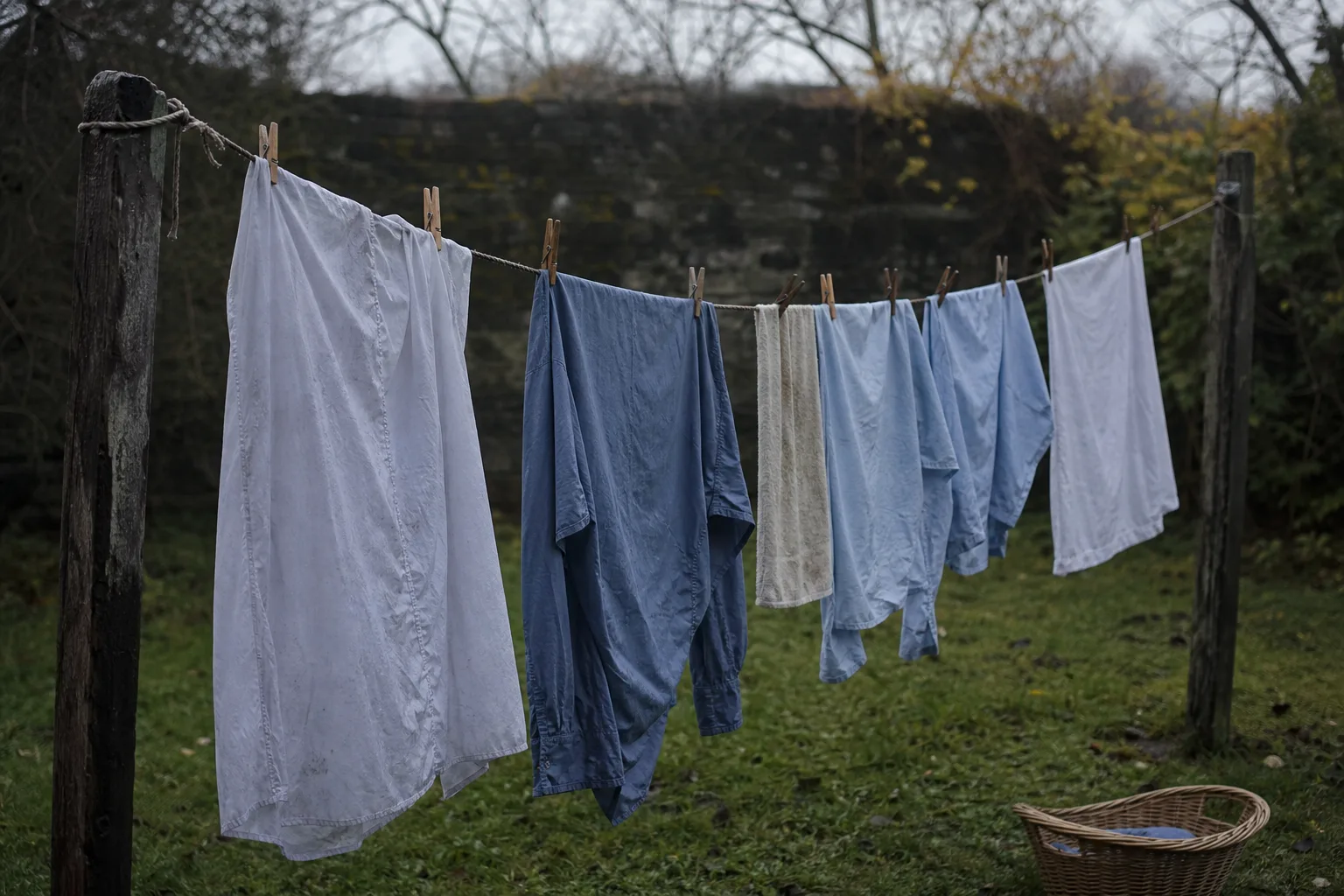
The basket sits at your feet, damp and heavy. Wet cotton, soaked through. A different density than dry cloth. It pulls down even before you lift it, and this is the first lesson of the line: gravity makes its presence known not with a crash, but with a quiet, insistent drag.
You lift the first shirt. The water clings to the threads, and the threads cling to the weight, and there’s no arguing with either. You can wring it till your hands ache, twist the fabric like you’re punishing it for being wet. But the weight remains. The water, like certain memories, insists on its presence. Not lost, exactly. More like transformed, suspended, waiting for time and air to do their work.
The clothespin—wooden, worn smooth by seasons of use—is a small hinge of attention. One hand holds the sodden fabric, the other applies the spring-tension, and in that moment you cannot be anywhere else. You’re here, preventing a shirt from falling into the mud. The modern mind rebels against such small, repeated attentions. Calls them inefficiencies. But the clothespin insists: this is the work. Not getting the laundry done, but the doing of it.
The wood itself tells a story. Grey patina, like fence posts or your own knuckles. It splinters sometimes, revealing that even the strongest holds are temporary.
The line sags under the load. A rope strung with a full wash is never truly taut. It takes the weight, accepts the bend. This gentle curve under collective weight reflects something of a life strung with unresolved threads. Each item pegged—sock, shirt, towel—becomes a quiet acknowledgement of what must be borne. The line becomes a kind of secular rosary, each pin a bead, each garment a marker of the week just passed: the grass stain from the garden, the sweat from the argument, the tea towel marked with yesterday’s stew.
Then the wind arrives.
It comes in gusts, tugging at sheets like forgotten arguments resurfacing. It wraps a towel around your neck, cold and unapologetic, and you realize you’re not the sole arranger here. The wind has its own logic of chaos and connection. You can fight it, pin things tighter, pull them straighter. Or you can accept its partnership, watch the laundry become a living thing, a conversation between your order and its wildness.
Either way, the weight remains.
The drip line beneath the clothesline, that dark stripe in the grass where water falls for years in the same spot, is another quiet insistence. The tumble dryer offers a violent, frantic end. The line offers slow, gravitational redemption. Drop by drop, the water surrenders to the earth’s pull. Not evaporation, exactly. More like confession—a slow release of what’s been held too long.
A memory is like that, perhaps. Not something to be blasted away with positive thinking, but a weight that needs acknowledging, hung out in the open, allowed to lighten under the steady gaze of time. Gravity insists you wait. You cannot rush the drying of a soaked towel any more than you can rush the integration of a grief.
There’s a rhythm to it. Bend, lift, pin. Bend, lift, pin. The body falls into a pattern the mind can no longer sustain. The mind grows restless, wants to be elsewhere, but the hands know the work. Sock, shirt, tea towel. Something like a rosary without the religion. The value isn’t in variety but in the return. Same motion, same pins, same line. You’re not achieving holiness; you’re wearing a groove in the day, a small trench of attention that keeps you present to the world’s simple, recurring needs.
This is maintenance that undoes itself. Clothes get dirty, you wash them, they get dirty again. Sisyphean, perhaps, but necessary.
The line-dried shirt is never without its wrinkles. The crease where the rope pressed, the fold where the pin held. The modern solution is steam, starch, a violence of heat to erase all trace of the journey. But the wrinkle is the shirt’s history written on its skin. To iron it out completely is to insist that the garment arrive in the world as if from nowhere, without a past. To accept the wrinkle is to accept that we are shaped by what carries us, that our own smoothness is less interesting than the creases earned by weather and weight.
Sometimes a peg slips. A towel falls into the dirt. There’s no outrage, only the small grief of repetition. You rinse it, wring it out, pin it up again. The work undoes itself daily. The clean becomes dirty, the dry becomes wet, the held becomes dropped. This is what it means to carry the world, not to transcend it.
The line itself becomes a kind of domestic horizon, where private things—your underwear, your sheets—are made public. It’s a quiet declaration: I am still here, I still do this work, I haven’t disappeared into convenience.
And when the wind blows it all down—when a sheet lands in the mud, or a sock goes missing—there’s a reminder that even the most careful pinning can’t hold forever. The rope itself, frayed and stained from seasons of use, bears witness to years of patience. It holds without complaint, though it sags. Always sags.
Gravity never leaves. The weight is always there, in fabric, in memory, in the old rope strung between two posts. Hanging laundry is not about getting things dry. It’s about learning to wait under the pull of things you cannot control, to hold what is heavy without pretending it is light.
You are not here to transcend the world. You are here to learn how to carry it. The gravity of wet laundry, the resistance of the wind, the slow work of drying—these aren’t obstacles to overcome but teachers. They insist on a patience that’s often forgotten, a presence rarely practiced.
The clothes return. Always return. And with them, the invitation to carry a little more, a little longer.
Might be. Might not.
Word, when there is word.