Essay XLV
Carrying the Watering Can
Full, it rearranges the whole body—the bite of the handle, the lean, the drops you carried for nothing.
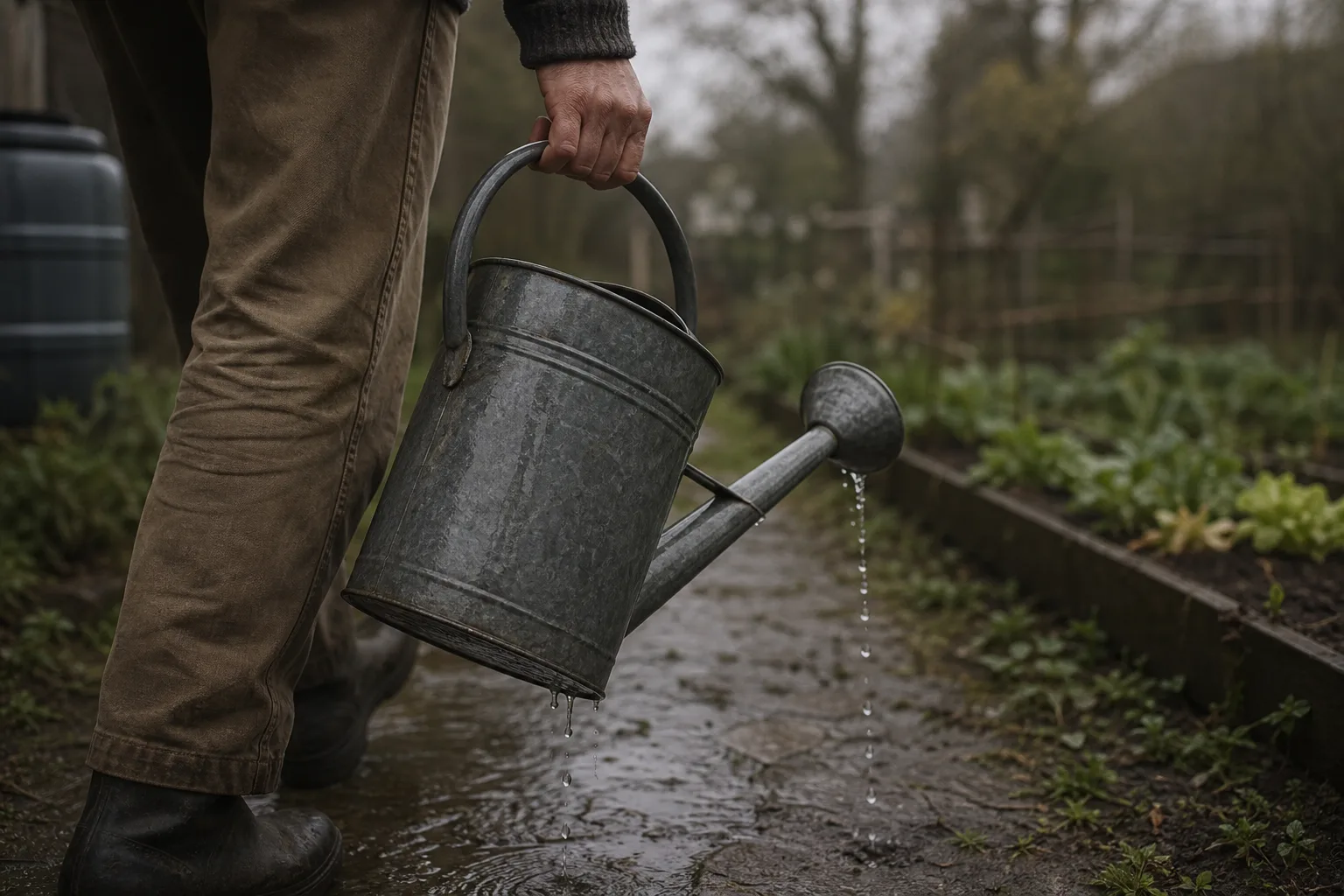
Full, it changes your whole body. You fill it at the butt, the water thundering in and the pitch rising as it nears the top, and then you lift it off the stand and everything about how you stand and move rearranges itself around the weight. It hangs off the one arm, dragging that shoulder down and out, and to keep from tipping you lean hard the other way, the opposite arm floating out for balance, your spine bent into a curve that isn’t yours, your walk gone lopsided and careful.
The handle bites. That’s the first thing — the thin metal or hard plastic of the grip cutting into your fingers and your palm, the whole loaded weight of the water concentrated onto that one narrow bar, so that before you’ve gone ten steps you’re already thinking about your hand, already wanting to swap arms. The can bumps against your leg. Water slops from the spout and the top with each step, a little cold splash onto your shin, onto your shoe, and you try to walk smooth to keep it in, a gliding careful gait, because every drop that jumps out on the path is a drop you carried for nothing.
And the bed is always at the far end. That’s the geometry of watering: the butt is by the house and the thirsty things are as far from it as the garden goes, so you carry the full weight the whole length of the plot, the shoulder burning now, the hand aching around the handle, the arm gone long and heavy, counting the steps, thinking about setting it down and knowing that if you set it down you’ll only have to lift it again. So you don’t. You carry it, leaning, lopsided, the water sloshing, all the way to the far bed.
Then you pour, and everything reverses. You tip the can and the water comes out of the rose in a soft broad hiss, spreading over the soil, sinking in dark, and with every second the can gets lighter in your hand. You can feel the weight leaving — the drag on your shoulder easing, the handle biting less, your body slowly coming upright as the load pours out of the spout and into the ground where you wanted it. The lean you’d built to carry the fullness becomes too much for the emptying can, and you straighten, and straighten, the arm rising easier, until the can is light as nothing and you’re standing square again and shaking the last drops out of the rose.
It’s a plain physical fact and it lands as one: the weight only leaves you by being given away. There’s no other way to be rid of it. You could set the full can down and walk off and your shoulder would stop hurting, but then nothing’s watered and the weight’s still there waiting to be lifted again. The only way the load actually lightens — really lightens, for good — is to carry it to where it’s needed and pour it out, let it go into the dry ground and the roots, until your hand is empty and your back is straight and the thing you were carrying is doing its work in the soil instead of hanging off your arm.
Then you walk back — light now, the empty can swinging easy from two fingers, your body your own again — to the butt, to fill it once more, because the far bed took what you brought and the next bed is still dry, and the whole lopsided carry begins again, weight out, weight poured away, weight out again, for as long as the garden’s thirsty and the summer holds.
Word, when there is word.