Essay XIII
Wringing the Cloth
A sodden cloth wrung rope-tight, the water forced out drop by drop—and the plain fact that it is never wrung dry, only wrung out.
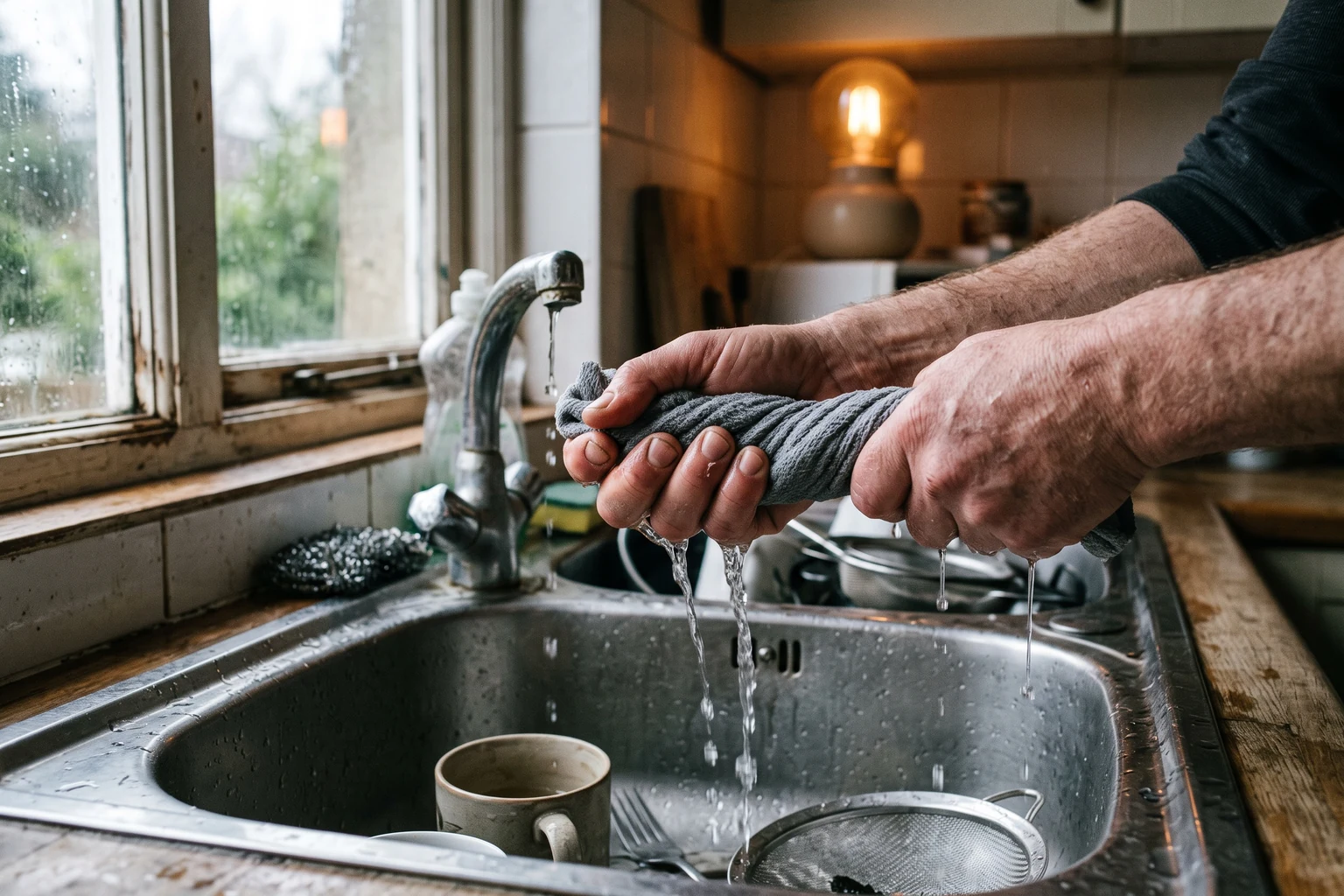
The cloth comes up out of the basin heavy, sodden through, water sheeting off it back into the grey suds. It’s twice its own weight now, maybe more, loaded with everything it soaked up wiping down the counter and the hob — a limp, dripping, shapeless thing that holds water the way a sponge holds it, in every fibre, unwilling to give it back for nothing.
So you make it. You gather the cloth up between your two hands and start to twist — one fist turning toward you, the other away — and the water comes. First in a rush, streaming off the bunched middle where the twist bites hardest, pattering down into the sink in a hard bright stream. You keep turning. The cloth ropes up on itself, going tight and thin and hard where a moment ago it was loose and full, the twist traveling out toward your hands, and the stream thins to a run, and the run to a fast drip.
Now it takes real effort. The easy water’s gone and what’s left is held deeper, and to get it out you have to wring harder — both wrists working against each other, the forearms tightening, that particular ache coming up along the inside of the arm from the elbow to the heel of the hand. You can feel the cloth resist. It’s wound as tight as it’ll go, a hard twisted rope of fabric, and still, when you crank the two ends another quarter-turn against each other, another few drops squeeze out of it, forced from the last wet corners, falling one, two, three into the sink.
There’s no dry to be had, is the thing. You can wring until your forearms burn and the cloth is twisted hard as a knot, and it will still be damp — cool and heavy-damp in the hand, water clinging in the weave too stubbornly to be forced out by any grip you own. The last of it stays. A cloth is never wrung dry, only wrung out, which is a different and lesser thing, the water reduced but never beaten, some of it always kept back down in the fibres where your strength can’t reach.
You let the twist go and the cloth springs back, half-unwinding, crimped all over now with the marks of the wringing, cooler and lighter and stiffer than it was. You shake it out and it hangs from your hand crumpled and damp, wiped of most of its water, ready to go back to the counter and soak it all up again. And it will. That’s the whole cycle of a dishcloth: soak and wring, soak and wring, load it up with the day’s spills and squeeze it near-empty and load it up again, the forearm aching a little each time, the water never wholly leaving, the cloth never wholly dry.
You drape it over the tap to drip, and even now, wrung as hard as you could wring it, it drips — slow, from the lowest corner, a bead gathering and falling and another gathering behind it, the water you couldn’t get out finding its own slow way down while the cloth hangs there and lets it go on its own time, in its own drops, long after your arms have given up trying.
Word, when there is word.