Essay XV
The Dough Remembers
Flour and water refusing their marriage, and the moment under the heel of the hand when the mess turns, all at once, to something smooth and alive.
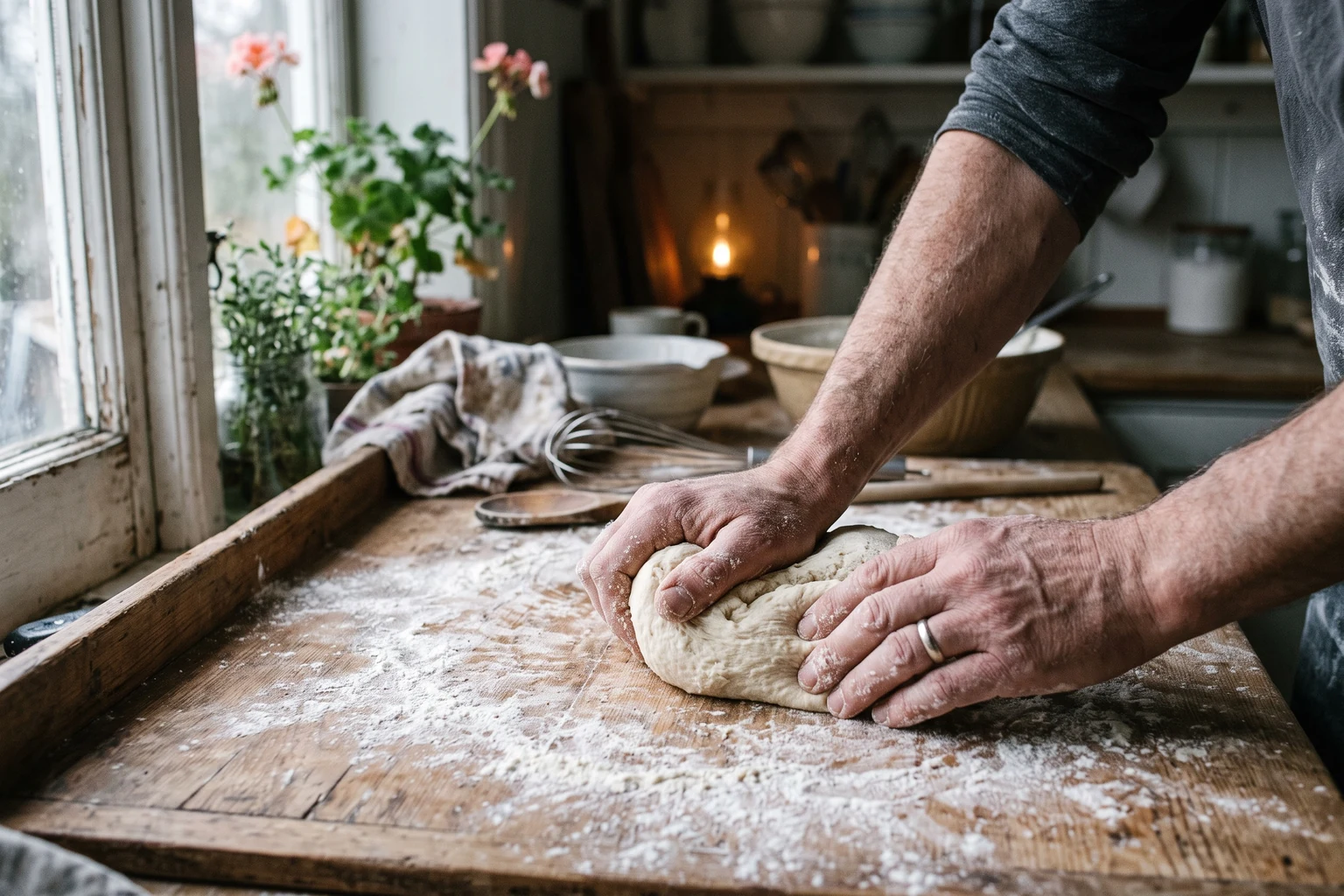
The dough sticks to everything at first. Your hands, the board, the bowl. It’s an honest kind of mess—flour and water refusing their marriage, clinging to whatever they touch instead of each other. You dust the board with more flour, knowing it won’t be enough. Never is. The first push of your palm meets something that’s not quite resistance. More like incomprehension. The dough doesn’t know what you want from it yet.
This is where the work begins. Not in the mixing, which is just introduction. Not in the measuring, which is only hope dressed as precision. The work begins when your hands meet the mess and start the ancient rhythm: push, fold, turn. Push, fold, turn. Your grandmother did this. Her grandmother before. Not because they were nostalgic, but because they were hungry.
The friction builds slowly. First in your palms, where the heel of your hand meets the board through the dough’s body. Then in your shoulders, which remember they exist. The dough warms under your touch—not metaphorically, but actually. Your body heat becomes part of the process. Thirty-seven degrees Celsius, bleeding into flour and water, teaching them how to become something else. The yeast wakes to this warmth. Begins its slow breathing.
People want to make this romantic. They talk about mindfulness, about being present, about the meditative quality of kneading. I’ve never found it so clean. My mind wanders. Sometimes to the electricity bill. Sometimes to nothing. The work doesn’t care what you’re thinking. It only cares that you keep going. Push, fold, turn. The dough fights back, not with malice but with memory. It remembers being separate things—flour in a bag, water in a tap. You’re asking it to forget.
Ten minutes, the recipes say. Or “until smooth and elastic.” As if time were reliable. As if your hands and my hands mean the same thing. The truth is simpler: the dough tells you. One moment it’s tacky, leaving bits of itself on your skin like accusations. The next, it’s suddenly cohesive, pushing back with something like playfulness. You can feel the gluten forming under your palms, these long proteins finding each other, making networks you’ll never see but your teeth will know tomorrow.
The machine could do this. Three minutes in a stand mixer, clean hands, predictable results. I own one. Sometimes I use it. But the machine never learns anything. Never feels the dough change from cold to warm, from shaggy to smooth. The machine doesn’t know about the specific ache that builds in your right shoulder, the one that reminds you of your father kneading dough on Saturday mornings, back when he still did such things.
Here’s what abstraction can’t hold: the way flour settles into the creases of your knuckles. The particular sound wet dough makes against wood—not quite slap, not quite whisper. The heat in your palms after five minutes, after ten. These aren’t metaphors for something else. They are the thing itself.
You knead while hungry, sometimes. This is its own education. The smell of yeast activating, the promise of what’s coming, while your stomach tightens around its emptiness. Delayed gratification as physical fact. Your body wants bread now. The dough needs three hours. This gap—between wanting and having, between hunger and satisfaction—this is where we live. Always have. The internet promises to close such gaps, to make everything instant. The dough refuses. It rises on its own schedule or not at all.
When the dough finally yields—and it does yield, eventually, even the stiffest dough—you shape it into a ball and set it aside. Covered with a damp cloth, like covering a mirror in a house of mourning. Now comes the waiting. Proofing, they call it. As if the dough needs to prove something. What it’s really doing is breathing. The yeast eating sugar, exhaling carbon dioxide, creating these tiny pockets that will become the crumb. Chemistry so ancient we’ve built entire civilizations around it.
The waiting is work too, though it looks like nothing. You clean the board, scraping dried bits with a bench knife. You wash your hands, but the flour stays under your fingernails. A kind of receipt. Evidence of what your morning held. You could do other things while the dough rises. Check email. Read the news. But sometimes you just sit there, watching the cloth rise imperceptibly. Learning again what time feels like without a clock.
When you punch the dough down—terrible phrase for such a gentle collapse—you feel it exhale. All that trapped air sighing out. You knead again, briefly. Shape the loaf. The second knead is different. The dough knows your hands now. Knows what you’re asking. It cooperates, mostly. You form it into something that might become bread, though there’s no guarantee. Sometimes the yeast dies. Sometimes the oven’s wrong. Sometimes you forget and it burns. This, too, is part of it.
The smell of baking bread colonizes a house. Gets into everything—curtains, clothes, hair. You can’t escape it, this evidence of transformation. When the loaf finally emerges, brown and imperfect, you’re supposed to let it cool. The crumb needs to set. Another waiting. But you tear off the heel while it’s still too hot, burning your fingers slightly. The steam escapes. The butter melts immediately.
You eat. The hunger dims but doesn’t disappear. Never does, completely. You’ll be hungry again tomorrow, and tomorrow you might knead dough again, or you might buy bread from the shop, wrapped in plastic, pre-sliced, reliable. Both are choices. Neither is pure.
This is what happens when you knead dough: you learn what your hands can do when they’re not typing, swiping, clicking. You learn that some hungers can’t be optimized away, only met, temporarily, with work that leaves flour under your fingernails and an ache in your shoulders. The bread rises, eventually. But it’s the friction in your palms that stays with you. The memory of resistance becoming cooperation becoming food.
Your body’s still here, wanting. The dough reminds you.
Word, when there is word.