Essay XXIII
Coiling the Hose
The long green serpent sprawled across the garden after the watering, and the last small unwilling job of coiling it kink-free onto its hook.
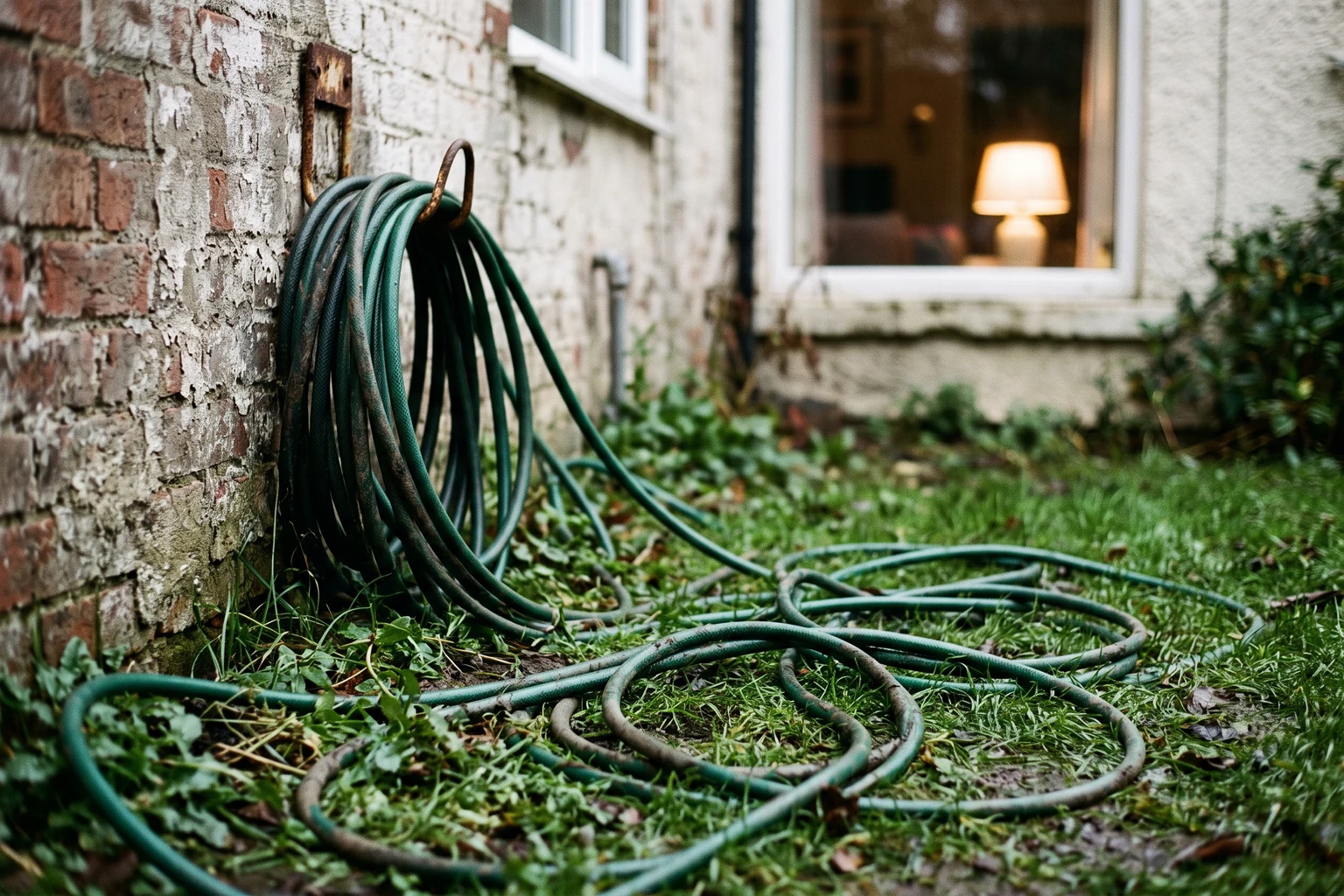
The hose never lies where you left it. You’ve finished the watering, and now there’s this long green serpent sprawled across the whole garden, looped through the beds, kinked around the tap, doubled back on itself in the middle of the path — and the last small job, the one you’d rather skip, is to gather it all up into something that isn’t a hazard. You pick up the free end and start to pull it toward you, and the garden fights back.
It comes reluctantly. The hose has spent the last hour lying in the sun and it’s warm and slack and full of its own ideas, and where it’s crossed over itself it’s found a way to knot, so that pulling one part just cinches another tight around the tap leg. You free it, and pull again, and a kink forms — that sharp flattened fold where the hose doubles too hard on itself, cutting off the last dribble of water, a bend that has to be shaken out or it’ll set there and weaken. You give the hose a flick, a wave sent down its length, and watch the kink travel away and release.
Then the coiling, and this is where the hose reveals its real nature, which is memory. It remembers every shape it’s ever held. Coil it against its grain — just loop it hand over hand the way it seems you should — and it fights you the whole way, twisting, wanting to spring back, each loop putting a half-turn of tension into the length that has to go somewhere, and where it goes is into a figure-eight tangle the moment you set it down. The hose has a curl it was born with, the curl of the reel it was wound on, and it wants that curl and no other.
So you learn to work with the twist instead of against it. You let each loop take the turn the hose wants to give it, rolling the hose a little in your hand as you bring it round, laying loop on loop so the coils nest sweetly instead of fighting — and when you get it right the difference is night and day, the hose falling into a neat flat spiral almost on its own, each coil the same size, the whole thing settling into a shape it’s happy to keep. Get it wrong and every coil is a small argument, the tension building until the pile bucks and springs and won’t lie flat.
There’s a rhythm to it once you find it: gather a length in one hand, feel the twist it wants, roll it in, lay the loop down, reach for the next. The hose slides through your grip, warm, faintly gritty where it dragged through the beds, smelling of rubber and sun-warmed water. The coil grows in your hand or at your feet, loop stacking on loop. And the kinks you find along the way you shake out, and the knots you patiently unpick, because a hose put away with a kink in it keeps that kink, sets it, so that next time you unroll it there’s a permanent weak crimp exactly where you were careless today.
You hang the finished coil on its hook, and it holds its round shape, and hangs there quiet and ordered — a thing that was chaos across the whole garden five minutes ago, gathered now into a tidy spiral, tamed. But only just, and only for now. It’s still full of the memory of every shape it’s held, still holding its tension coiled and waiting, and the moment you take it down and drag it out to the far bed tomorrow it’ll twist and loop and kink and knot exactly as it pleases, remembering its own shape better than any order you tried to impose, needing to be gathered up and reasoned with all over again.
Word, when there is word.