Essay XXIV
Ironing a Shirt
A shirt come to the board a wreck of creases, and the slow hiss and press by which heat and steam talk it back into shape.
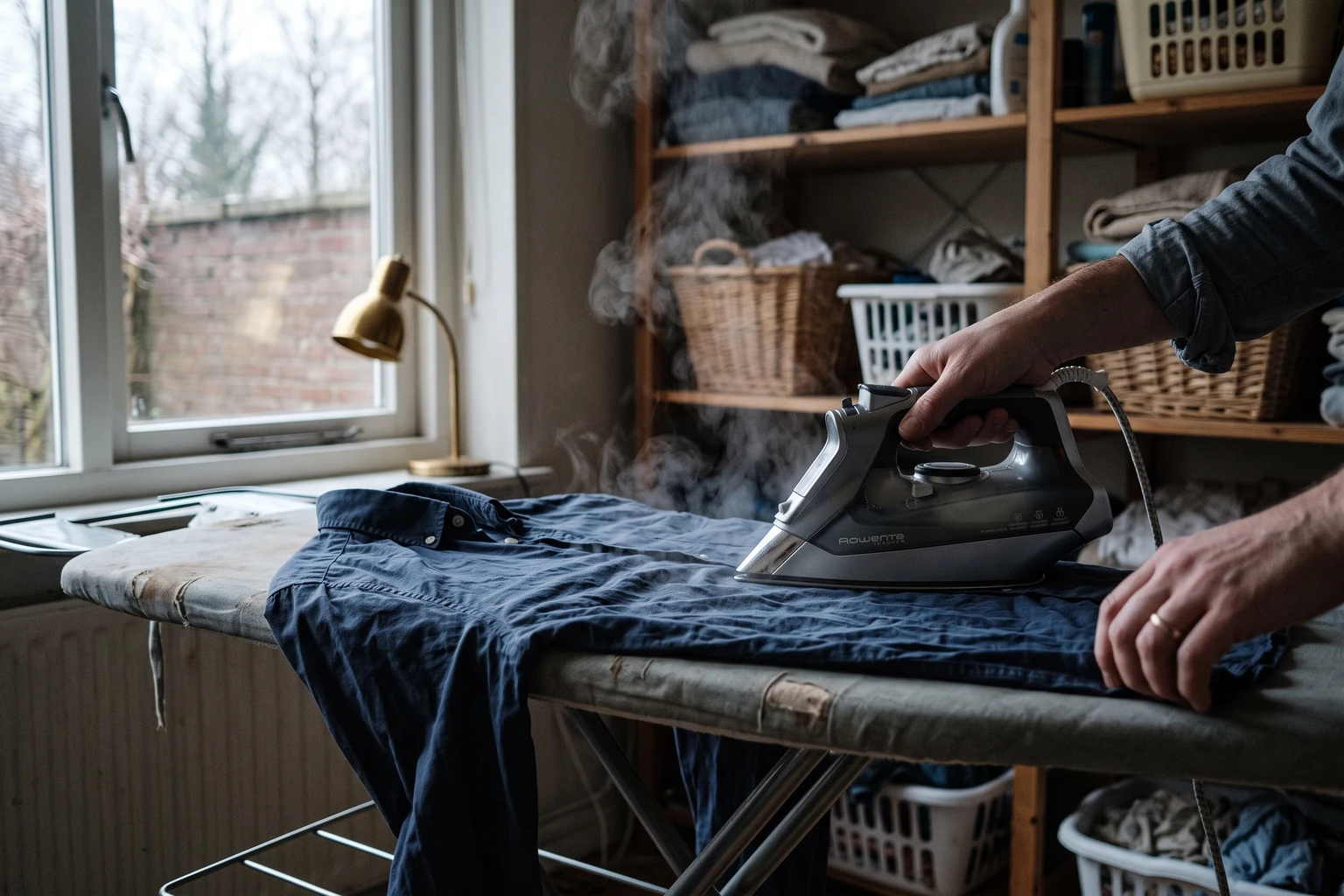
The shirt comes to the board a wreck — dried in a heap, or off the line stiff and creased where the pegs held it, the collar buckled, the sleeves twisted, a whole topography of wrinkles pressed in by however it was left. You spread it out over the board, and it lies there rumpled and uncooperative, and you set the iron on its heel to heat and wait for the little light to tell you it’s ready.
You feel the heat before you use it — hold your hand a few inches off the plate and there’s that dry radiant warmth, the smell of hot metal, the faint tick of the thing expanding. Then the water. You press the button and the steam comes out of the soleplate in a hiss and a soft white cloud, and that’s the trick of the whole business: not heat alone but heat and water together, the steam going into the cotton to loosen the fibres so the weight and the warmth of the iron can press them flat and hold them there while they cool.
You start with the collar, always, because it’s small and stubborn and sets the tone. You lay it flat, wrong side up, and run the iron along it, and the wrinkles vanish under the plate — that’s the thing you never quite get used to, the way a crumpled thing goes smooth in the wake of the iron like water closing over a stone. The steam hisses. The cotton dampens and flattens and dries flat, and where there was a buckled ruck of fabric there’s a crisp clean edge. You can feel the resistance of a deep crease through the handle, and you go back over it, pressing, a little more steam, until it gives.
Then the yoke, the sleeves, the cuffs, the long front panels, each with its order, each laid flat and swept smooth. There’s a rhythm to it — set, press, glide, lift, reposition — and a real satisfaction in the transformation, the most direct there is in any of this: rumpled goes in, smooth comes out, no waiting, no soaking, no negotiating, just the flat hot plate erasing the creases one pass at a time. You press a sleeve and lift the iron and there’s the flat panel of it, gleaming faintly, every wrinkle gone, and you feel briefly and simply competent in the way that only tasks with visible results allow.
But there’s a small violence in it too, and you feel that if you slow down. You’re not just smoothing the shirt — you’re erasing it. Every crease you press out is a record of something: the fold where it hung, the bend of the arm that wore it, the peg-mark from the line, the whole soft history of the last time it was worn and washed and dried. The iron takes all of that away. It presses the cotton back to a blankness it hasn’t had since it was new, flat and creaseless and anonymous, a shirt that looks like it just arrived in the world with no past at all. That’s the point of ironing, and it’s worth knowing it’s the point: to send the shirt out looking as though nothing had ever happened to it.
You do the buttons, nosing the iron’s tip around them. You give the whole thing a last pass, and hang it while it’s still faintly warm, because it’ll hold the smoothness best if it cools on the hanger rather than folded. And there it hangs, crisp and blank and clean-lined, the wreck of an hour ago gone completely, pressed out of existence by heat and steam and the flat patient weight of the iron — smooth as if it had never been worn, which is exactly the look you were after, and, if you stand back and think about it, a slightly strange thing to have wanted.
Word, when there is word.