Essay XXVI
Splitting Kindling in the Rain
Splitting kindling in the rain, the wet wood clinging to itself and refusing the axe—resistance not as malice but as instruction.
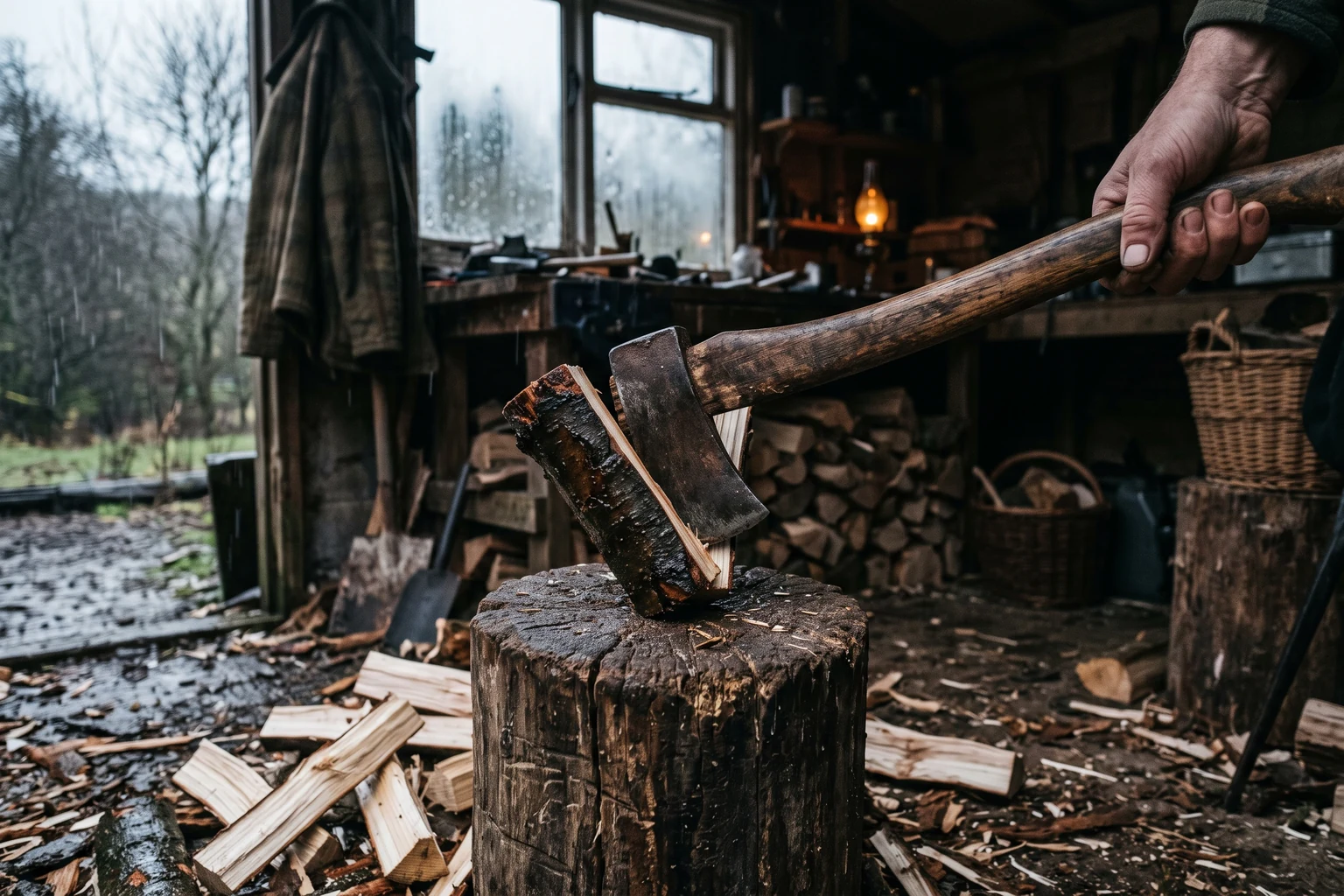
The rain doesn’t ask permission. It arrives with a weight that settles into everything—the air, the woodpile, the shoulders of your jacket. You feel it first in the sleeves, the way they drag heavier with each swing of the axe, as if the water were conspiring with the wood to resist you.
There’s a particular sound to wet wood under an axe. Not the sharp report of dry cedar, which cracks open like a door flung in anger, but a damp, heavy thud. The blade bites, but the log absorbs it. The grain swells, the fibres cling to one another like old friends reluctant to part. What split easily yesterday holds fast today. Water has a way of exposing what’s hidden—knots you didn’t notice, twists in the grain you’d overlooked.
The wood says no, not out of malice but out of its own nature.
Might be that this is the first lesson: refusal as instruction. The rain doesn’t care about your timeline, your dry clothes, your desire for efficiency. It’s the world’s indifference made tactile, and you’re here to negotiate with it, not conquer it.
The thing is, though, you still need kindling. The work must be done anyway. Not if you want a fire by evening, not if you want the small mercy of warmth in a house that holds the damp like an old grudge. You don’t get to wait for better conditions. The world doesn’t optimize for comfort.
Wet wood is heavier, but not only heavier. The weight distributes strangely. One end sodden, the other less so, so each swing is a small gamble. Sometimes the axe glances off, finding nothing but slick bark; sometimes it sticks fast and must be wriggled free. You’re not looking for balance, exactly. More like the art of bearing asymmetry without dropping the whole thing.
Your hands grow cold quickly, the kind of cold that seeps into the bones and makes the axe handle feel slick. But your core stays warm—a slow burn from the effort, not the outcome. It’s a strange paradox, the body rationing heat, deciding what’s essential. The fingers numb, the shoulders burn. You’re carrying the cold in one part, the warmth in another, and perhaps this is what it means to be embodied: to hold both at once, to let neither define you entirely.
This is the difference between being wet while moving and being wet while still. In motion, the cold is manageable. Each swing, each step back to reset the log, keeps the blood moving. There’s a kind of insulation in effort. But pause, and the cold seeps in, filling the spaces you’ve made. The body, like the fire you’re working toward, wants to be fed. Stillness is surrender; movement is a kind of prayer—something like liturgy, if liturgy could be performed with an axe and a pile of stubborn logs.
There’s an honesty to the axe that I’ve never found in abstractions. It doesn’t care if you’re cold, or if the wood is wet, or if you’d rather be somewhere else. The blade requires you to show up as you are, with whatever patience you can muster. Wet wood isn’t split by willpower or cleverness. It’s split by repetition. By learning to read the shifting grain, adjusting each swing, accepting that some pieces will never yield cleanly. Some logs only tear, fibres stringing out like tendons, the break untidy but sufficient.
There’s a futility to it, almost comic. You get wet to make something that will dry you later. The act is cyclical, not progressive; no one splits kindling in the rain to build a future, only to answer a need that returns as regularly as the weather. You’re not conquering anything, least of all the elements. You’re just participating in the world’s refusal to become easy.
Your grandfather did this. His father before him. The repetition isn’t the point—the repetition is the point. Maintenance as the only liturgy left to us. You wonder if they felt the same cold in their hands, the same warmth in their core. If they noticed how the rain made the wood smell different, richer, more alive. Or if they, too, thought about the weight of being here, not in some transcendent sense, but in the literal sense of standing in the rain, swinging an axe, splitting kindling.
The rain itself becomes an uninvited sacrament. Not a chosen spirituality, this, but one that chooses you, seeping in regardless of your consent. A cold baptism into the present moment. The water anoints the wood, making it heavier, darker, more solemn. It anoints you too, the dampness clinging to your clothes, the smell of wet wool and split pine that will cling to you for hours.
Modern life is built on the promise that you’ll never have to do this. That you can wait for dry weather, or better yet, buy kindling already split and stacked, delivered to your door by someone else’s wet hands. But the truth is, the world doesn’t optimize for comfort. Not really. The work returns. Always returns. The rain, indifferent to your schedule, baptizes you into necessity.
You discover that suffering isn’t always something to be solved; sometimes it’s just the condition for certain kinds of work. Certain kinds of presence.
The work is slow, the progress uneven. A log splits cleanly on the third try, another shatters uselessly. Effort doesn’t guarantee success, but you keep at it anyway. Because the doing itself is the yield. The warmth you’ll feel later, when the fire finally catches, isn’t just from the flames. It’s from the knowledge that you carried the weight, that you stayed with it even when the rain made it heavier.
You come inside at last, dripping, fingers stiff. The warmth hurts before it helps. The kindling you’ve made will need time to dry, perhaps days before it will catch. There’s no shortcut; the cycle can’t be rushed. You sit by the stove, listening to the rain on the roof, and realize you’ve carried something more than wood.
The world is heavier for its wetness, but so are you, and the weight is not always a burden. Sometimes it’s just the sign that you were here, that you did what needed doing, in the weather that arrived.
You are not here to transcend the world. You are here to learn how to carry it. Even, and especially, when it rains.
Word, when there is word.