Essay LII
The Liturgy of a Stuck Window
A window painted shut for twenty years, and the difference between forcing it and learning to read the seal.
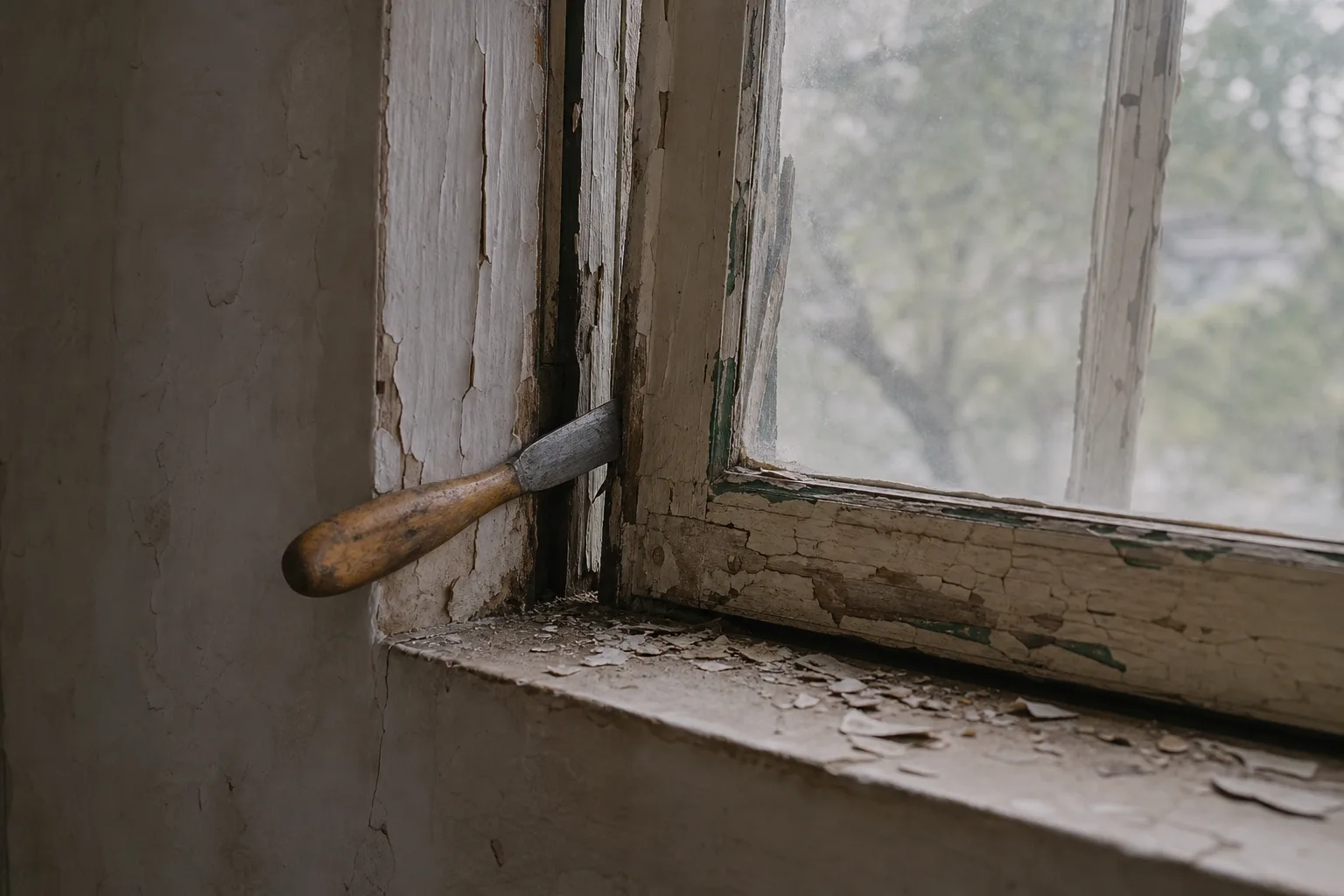
The window in the back room hasn’t opened in years. Perhaps decades. You can tell from the brush marks—thick over thin, pale gloss hurried over faded green, itself sealing a memory of brown beneath. Each layer a season, a tenant, someone rushing to be done. Paint has run down onto the sash, pooling in corners, binding wood to wood with the indifference of time.
You discover this on a Thursday afternoon when the room’s air grows close and you decide, for no particular reason, that it’s time for a draft.
The first attempt is always a negotiation of force. Palms flat against the lower rail, you push up, expecting the little resistance you get from a stuck drawer. Nothing moves. You try again with a grunt and twist of the hips, as if will might supplement technique. The window doesn’t budge. You fetch a screwdriver—never the right tool, but the nearest. Wedge it under the sash, lever up, paint flaking off in unsatisfying scales. The wood groans but nothing yields. There’s a particular sound that comes from wood under duress, a low complaint that isn’t quite a creak. The material telling you, quite plainly, that you’re misunderstanding the problem.
The screwdriver slips, gouging the frame. You curse. The window remains unmoved.
There’s a particular frustration in meeting the limits of your own force. You feel it in your forearms, the way muscles tighten and release with nothing to show. You want to blame the window, the previous owner, the universe. But the window is only doing what it’s been told—stay closed, sealed by hands that came before. You stand back, looking at the mess: chips of paint, a new scratch, dust on the sill. The air no fresher.
You give up. For now.
This giving up, though—it’s not failure. Not exactly. More like a necessary liturgical pause. The Sabbath of the stuck window. You leave it, but the problem continues working in you, subcutaneously. The solution arrives not in the heat of struggle but in the quiet of the kitchen, hands wrapped around a mug, gaze drawn to the window from a new angle.
The work continues even when you’re not doing it.
Next morning, the memory of stubbornness lingers in your shoulders. You make tea, let steam gather on the panes. Notice, perhaps for the first time, how morning light catches in the brush strokes, highlighting the unevenness, the history of hurry. Remember your father, who never forced anything mechanical, who would’ve reached for a putty knife instead. You don’t have one. Borrow one from the neighbour across the hall—an old man who tells you to “score the seal, not the wood.” Advice given without ceremony but with the weight of experience.
Back at the window, the work slows down. The putty knife slides tentative into the seam between sash and frame. Paint resists at first, then yields with a muted crackle. Not the sharp snap of splitting wood, but the dry report of old adhesion letting go. You learn to listen for it—the difference between progress and damage. Too much pressure and you’ll scar the grain; too little and nothing happens.
It becomes a kind of conversation, your hand asking, the window answering in creaks and sighs.
The paint itself is a historical record. Twenty summers and twenty winters, each coat a season of someone’s life. The window isn’t merely stuck; it’s sealed in its own biography. The work is not to defeat it but to carefully read that history, separate the most recent impatient layer from the older, more brittle ones. You work your way around the perimeter, inch by inch, the knife’s blade now an extension of intention, not impatience.
There’s a shift in your grip as hours pass. At first all tension, muscles braced for resistance. But the window teaches you otherwise. Force is not leverage; leverage is intelligence. The physics of acknowledging your own weakness. You’re not strong enough to move it directly, so you must find the pivot point, the place where the world itself will multiply your effort.
Applying this principle is an act of humility.
You learn to press and rock, not shove and wrench. The window asks you to find its weakness, not impose your will. Pause when the blade sticks, angle it differently, try the other side. Sometimes stop altogether and listen—ear close to glass, attuned to the faintest creak that signals paint’s surrender.
The work is not heroic. It is attentive.
By evening, you’ve circled the window twice, scraping, scoring, prying. The frame scarred now, but not ruined. Paint chips scattered on the sill, a stratigraphy of neglect and maintenance. You try the sash again, gentler grip this time. There’s movement—a millimeter, perhaps two. Not the dramatic release you imagined, but a subtle shift.
Enough.
You stop. Let it rest. The window will open when it’s ready, and not before.
Next day is humid, wood swollen with overnight rain. The putty knife sticks in corners; glass fogs with your breath. You fetch a hair dryer, improvising heat where sun is absent. Paint softens, just a little. Work slowly, alternating pressure with patience. At some point, you realize you’re no longer frustrated. The work has become its own rhythm—scrape, pause, listen, adjust. Something like prayer, if prayer were physical and slightly dusty.
When the window finally gives, it’s not with a triumphant snap but a slow, reluctant sigh. The sash lifts inch by inch until a wedge of outside air slips through. The room changes immediately—temperature drops, smell of rain drifts in, light sharpens. You lean back, arms tired, shirt damp with effort.
The sill is littered with paint chips, flakes of old varnish, the byproducts of friction overcome. You leave them there for a while. To sweep up immediately would be to deny the work, the learning, the slow education of your hands. This dust is the physical evidence that something real, something friction-laden and material, has taken place here.
The satisfaction isn’t symbolic. The window opens. Air moves. You can hear the street below, the birds, the ordinary world returning. The room feels different—less abstract, more present. The window still scratched, frame still scarred, but now it functions. You carry the knowledge in your hands, in the new callus on your palm, in the subtle shift of your grip next time you meet resistance.
Your body remembers this. Next time, you’ll check the paint seal first, automatically. Knowledge below language. This is what the window teaches that no person could: patience without virtue-signaling, just physics. Makes you someone who knows about painted-shut windows.
The window will stick again, in time. Everything returns.
That’s the nature of maintenance—the only honest liturgy left to us.
Word, when there is word.