Essay XXXI
Driving a Nail
Setting the nail with a tap, then the swing from the elbow—the small acquired knack of driving a thing straight and home.
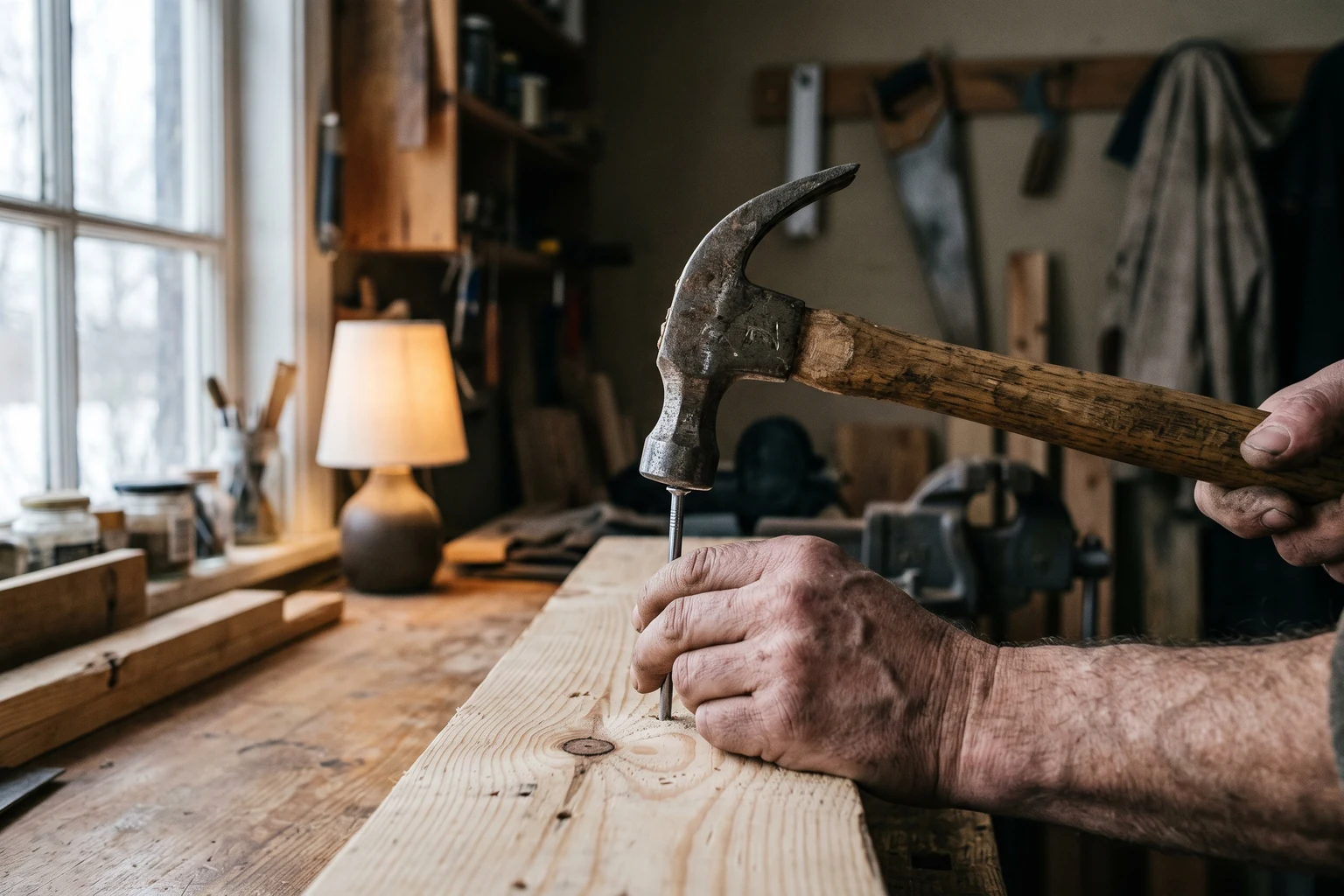
You pinch the nail between finger and thumb and stand it where you want it, point biting just into the wood, and the first job is only to set it — a light tap, a couple of them, the hammer swung from the wrist alone, just enough to sink the tip so the nail stands on its own. Then you take your fingers away. This is the moment of small faith every time: the nail alone, upright, and your holding hand withdrawn out of the arc of what comes next, because the hand that stays too long is the hand that gets hit.
Now the real swing. Not from the wrist — from the elbow, from the shoulder, the whole arm bringing the weight of the head down and letting the hammer be heavy the way it wants to be. That’s the thing the body has to learn and can’t be told: you don’t force the hammer down, you drop it, guided, and let its own weight do the driving. A tense arm swinging hard sends the blow crooked and tires you in three nails. A loose arm letting the head fall true drives the nail in four strokes and could go all afternoon.
When you hit it right you know by the sound. A clean, solid bock — round, final, the whole nail taking the blow down its length — and the nail leaps a quarter-inch into the wood. When you hit it wrong you know that too: a flat glancing click, the hammer skidding off the head at an angle, and the nail bends. There’s a particular disgust in a bent nail. It goes over sideways, kinked at the neck, and now every blow just bends it worse, folding it flat against the wood, and you either worry it back and forth until it snaps off or lever it out with the claw — that long complaining screech of metal dragging out of grain — and start again with a fresh one, a little humbler.
And sometimes, the thumb. Everyone who has driven nails has driven the hammer into a thumb, and the body remembers each time. The miss, the bright shock of it, the hammer finding flesh instead of steel — and then the pain arriving a half-second late, blooming up from the nail of the thumb, deep and hot and throbbing, the kind that makes you drop the hammer and grip the thumb hard in your other fist and stand there breathing through it while it pulses. A blood blister comes up under the nail, purple-black, and aches for days, and reminds you every time you reach for something exactly where you were careless.
But mostly, when the arm has found its looseness, it goes right. Tap to set, hand clear, and then the rhythm — bock, bock, bock — the nail walking down into the wood a clean bite at a time, the head getting closer to the surface, the pitch of the sound rising a little as less of the nail is left to ring. You feel the wood take it, feel through the handle whether you’re in soft clear pine or whether you’ve hit something — a knot, a hidden nail, a sudden hardness that jars back up your arm and stops the nail dead.
The last blow is its own small art. You want the head flush, or a hair below, seated tight against the wood — but the blow that seats it can also be the blow that leaves a half-moon of hammer-track bruised into the surface around it if you overshoot. So the last one you pull a little, softer, placed, bringing the head down level with the grain and no further. And there it is: flush, tight, holding, the two pieces of wood pulled together and made one thing by a length of steel your arm drove home with nothing but its own repeated weight.
You run your thumb — the good one — over the seated head. Smooth, cool, level with the wood. Then you pinch up the next nail, and set it, and take your hand away.
Word, when there is word.