Essay XL
The Friction of a Rusted Bolt
The seized, corroded bolt that will not turn for any spanner—the particular frustration of meeting a thing rusted past persuasion.
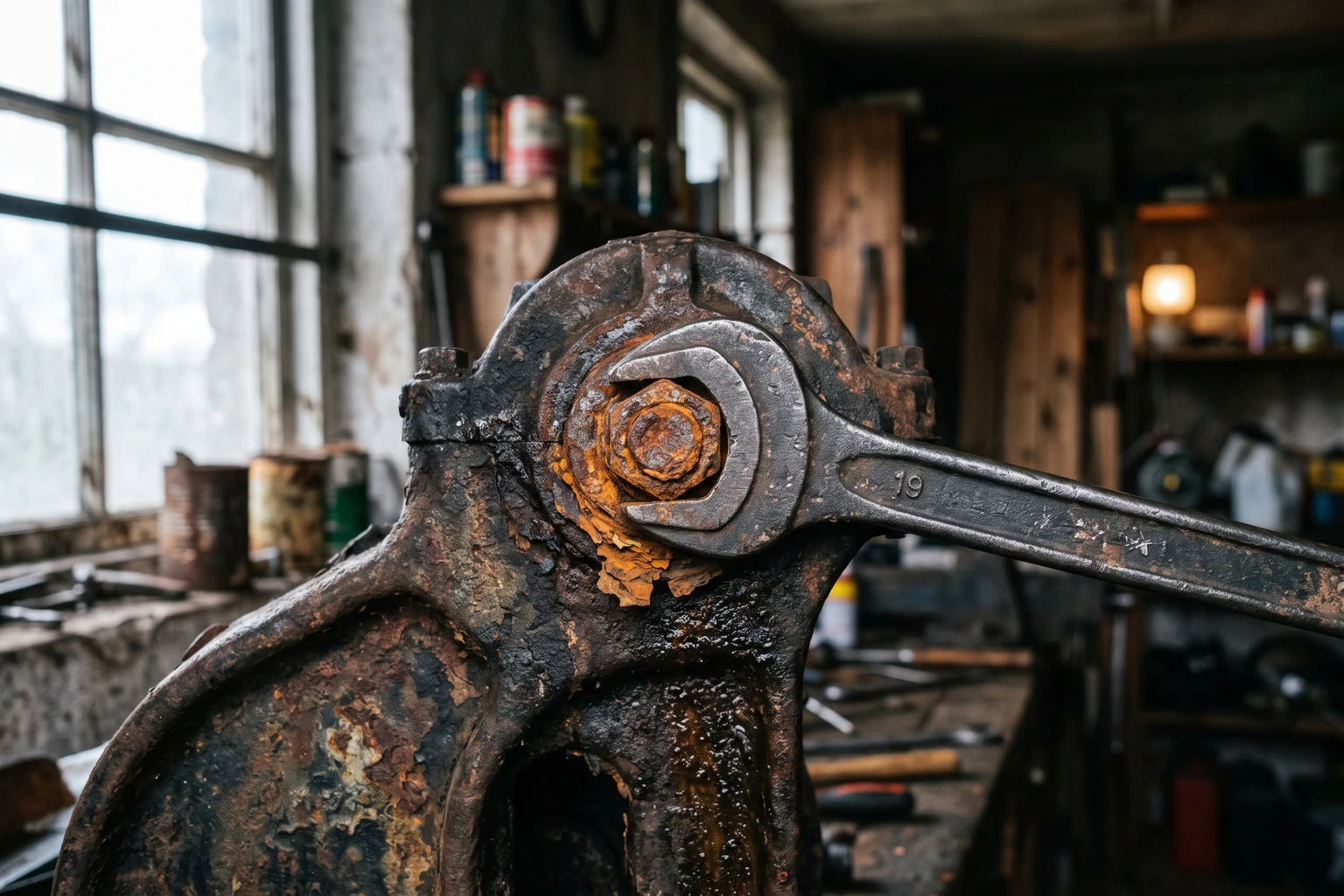
It’s always the same bolt. Not literally, perhaps, but in substance—the same seized, corroded thread refusing to yield beneath a spanner’s insistence. The one that won’t turn, no matter the angle of approach, no matter the muttered encouragements or threats. Somewhere under a car, or behind a shed door, or fastening the hinge of a gate that hasn’t swung freely in years. A small thing, but immovable.
I’ve met more of these than I care to count. The first time, I was twelve, tasked by my father to help replace the brake pads on an Escort that should have been retired the year before. My job was to “hold the torch and mind your fingers.” I watched as he leaned his whole weight into a ratchet, knuckles whitening, jaw set. The bolt did not budge. Sweat beaded on his brow, then rolled down to his chin. He tried again, and again, until finally—something gave. Not the bolt, but the knuckle: a sharp bark of skin against metal, followed by a hissed oath that hung in the air as sacrament.
The thing is, though, the world’s full of stuck bolts. Not only the literal kind, but the sort that appear wherever friction accumulates—rusted by neglect, seized by time, resistant to all but the most persistent effort. No amount of cleverness or abstraction will loosen them. You meet them in the flesh, or not at all.
This is what happens when you try to force a rusted bolt: the world answers back. There’s a kind of communion in that refusal—a negotiation between your will and the stubbornness of iron and oxidation. No algorithm, no “best practices” guide, just the slow, incremental yielding of metal under pressure and heat. You try to remember the sequence: soak with oil, wait, tap with a hammer to break the bond, wait some more. Wait longer than feels reasonable. Then, with the spanner steady, you lean in. Not a jerk, but a long, patient torque, feeling for the moment the threads remember their original purpose. Sometimes, nothing. Sometimes, a groan—metal against metal, like an old man rising from a pew.
There’s humility in this work. You’re not the master here. The bolt is not an obstacle to be overcome, but a fact to be carried. Your knuckles split, your palms blacken, your patience frays. You realize, after a while, that you can’t rush it. The more you push, the tighter the bond. Something like confession, if confession were measured in bruises and the ache in your wrist the next morning.
It’s not just about maintenance, though that’s part of it. It’s about the friction that keeps the world from flying apart. If every bolt spun freely, nothing would hold. There’s a necessary resistance—a reminder that connection is costly, that joining two things is never as simple as turning a nut on a thread. Rust is the record of contact, of air and water and time conspiring to make things difficult. It’s the patina of years, not an enemy but a witness.
You learn, after enough of these, to respect the bolt. Not to love it, exactly, but to see it as a kind of teacher. The lesson is not transcendence. You don’t rise above the stubbornness of matter. You kneel before it, spanner in hand, and stay with it. The world’s resistance is not a problem to be solved, but a weight to be carried. Might be that you never get it loose. Might be that the head rounds off, and you’re left with the quiet defeat of drilling it out, or leaving it be. Not every stuck thing is meant to turn again.
I’ve seen men throw tools across the garage, cursing the gods of rust and time. I’ve done it myself, once or twice, though it never helps. The bolt remains, unmoved. Eventually you return, quieter, hands steadier, accepting the possibility of failure. That’s when, sometimes, the bolt relents. Not because you deserve it, but because you stayed long enough for the metal to remember it was meant to move.
What’s true of bolts is true of most things worth keeping. Relationships, habits, old beliefs that no longer fit but refuse to be unwound. The more you force, the more they seize. You learn to live with the friction, to work around the stuck places, to apply oil and patience in equal measure. This is the liturgy of embodiment—not the clean, frictionless abstraction of thought, but the slow, grinding encounter with things as they are.
There’s a dignity in maintenance. In staying with what resists, in carrying the load even when it stains your hands and leaves you no cleaner for the effort. You don’t make the work sacred by talking about it. The sacrament is in the doing, in the scraped knuckles and the bruised pride, in the small, satisfying turn when finally, after all that, the bolt gives way. Not a victory, exactly. More like a reconciliation.
We live in an age of frictionless surfaces, of seamless interfaces, of information that arrives instantly, demanding nothing of our physical presence. We swipe, we click, we scroll—actions that require so little of our bodies, so little of our will. But resistance, it turns out, is not merely an annoyance; it is the very grain of reality. It is the friction that allows us to feel the world, to understand its contours, to know our own place within it.
The bolt returns. Always returns. In the next repair, the next hard conversation, the next morning you wake up and the world is just as heavy as before. You are not here to transcend it. You are here to learn how to carry it. Rust and all.
Word, when there is word.