Essay XLII
Shelling Peas
A lap full of pods, the thumb finding the seam, and the slow evening rhythm of shelling peas one canoe at a time.
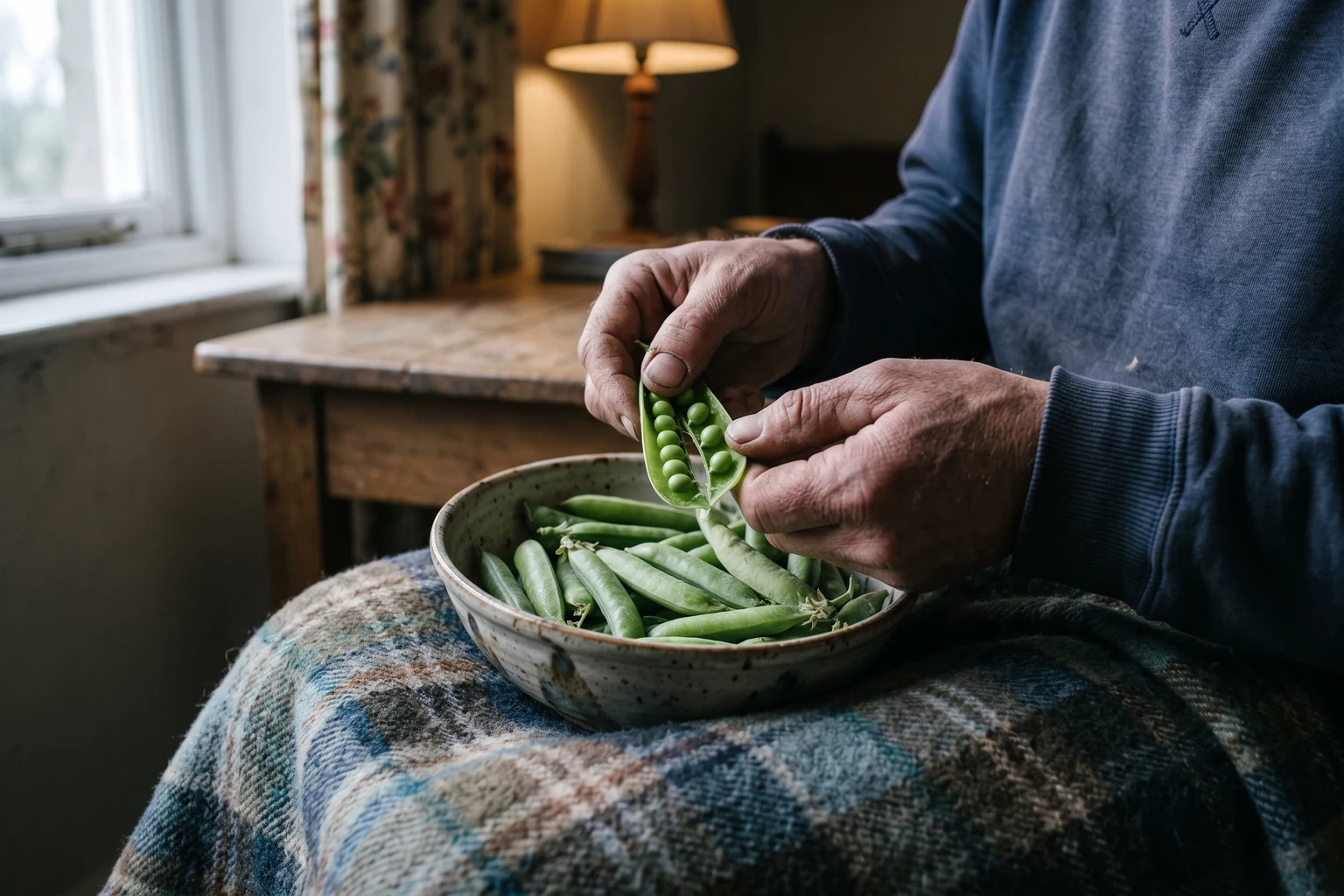
The pods come in a paper bag that’s gone soft at the bottom with their coolness, and you tip them into your lap, or into a colander, or straight onto the kitchen table if the evening’s long enough. A heap of them, green going on grey-green, curved like small canoes, some fat and taut and some flat where the peas never came to anything. They smell faintly of the field still — that raw green smell, cut grass and water, a smell that has nothing sweet in it yet.
You set a bowl between your feet or in your lap and you begin.
The first pod teaches you the motion. You find the stem end and snap it back, and it breaks with a small green crack and a thread of string peels down the seam if you’re lucky, unzipping the whole length. Then the thumbnail goes into the seam and you press, and the pod resists for just a moment — a tightness, a held-shut quality — before it gives all at once and splits open along its spine with a soft pop, and there they are. A row of them. Pale green spheres in a pale green cradle, packed in tight, each in its own slight dimple, glossy, cool, absurdly neat.
You run your thumb down the row and they come away and drop into the bowl. The first few land with a small hard sound against the china, a little tock, tock, and then as the bowl fills the sound goes softer, peas falling on peas, a muffled rolling patter. You eat one. You always eat one. It’s cold and it bursts between the teeth with a green sweetness that the frozen ones never quite have, a taste that’s mostly water and spring.
And then you do it again. And again.
There’s nothing to get better at, not really. The tenth pod is the same as the first. The hundredth. Your thumbs learn the exact pressure so that after a while you’re not looking, the hands working on their own, snap and split and sweep, snap and split and sweep, while your eyes drift to the window or the middle distance or nothing at all. The pile of full pods shrinks on one side and the pile of empty husks grows on the other, wet and bright inside, curling as they dry. The bowl fills by a pea at a time.
This is a task with no craft in it and no cleverness. You cannot do it well. You can only do it, or not do it, and if you want peas — real ones, shelled at the table an hour before supper — then there’s no way through but the long way, one pod, one thumb-split, one small green rattle at a time. Nobody’s optimised this. There’s no version of it that’s faster except the version where somebody else did it, or a machine did, or the peas came in a bag from the freezer aisle already parted from everything that grew them.
Your thumbnail goes green after a while, stained at the edge, and there’s a dampness to your fingertips, a slight roughness where the pods have had their way with your skin. The husks smell stronger than the peas. A few pods hide a grub, or a row gone brown and shrivelled, or peas so small they’re barely there, and you clear those aside without ceremony and reach for the next. The heap of full pods looks, for a long time, like it isn’t going down at all. Then all at once it’s nearly gone.
The tedium is the whole of it. That’s not a complaint. There’s a place the mind goes when the hands are busy with something that asks for attention but not thought — a low, wide, drifting place, half here and half elsewhere, where the evening light moves across the table and the bowl slowly fills and you’re not waiting for it to be over so much as you’ve forgotten to want it over. Snap. Split. Sweep. The small green sounds. The cool weight of the bowl growing heavier against your legs.
When it’s done you’ve a bowlful of peas that would fit in two cupped hands, for all those pods, all that time. A pile of empty husks going limp on the table. Green under your nails that’ll still be there tomorrow. You carry the bowl to the pan, and they go in, and in three minutes they’re brighter and hotter and sweeter and gone. But the shelling took an hour. The eating takes no time at all. Most of what mattered already happened, at the table, in the drift, one pod after another after another.
Word, when there is word.