Essay X
Darning a Sock
A hole worn through at the heel, a wooden egg, and the small woven island of new cloth built thread by thread across the gap.
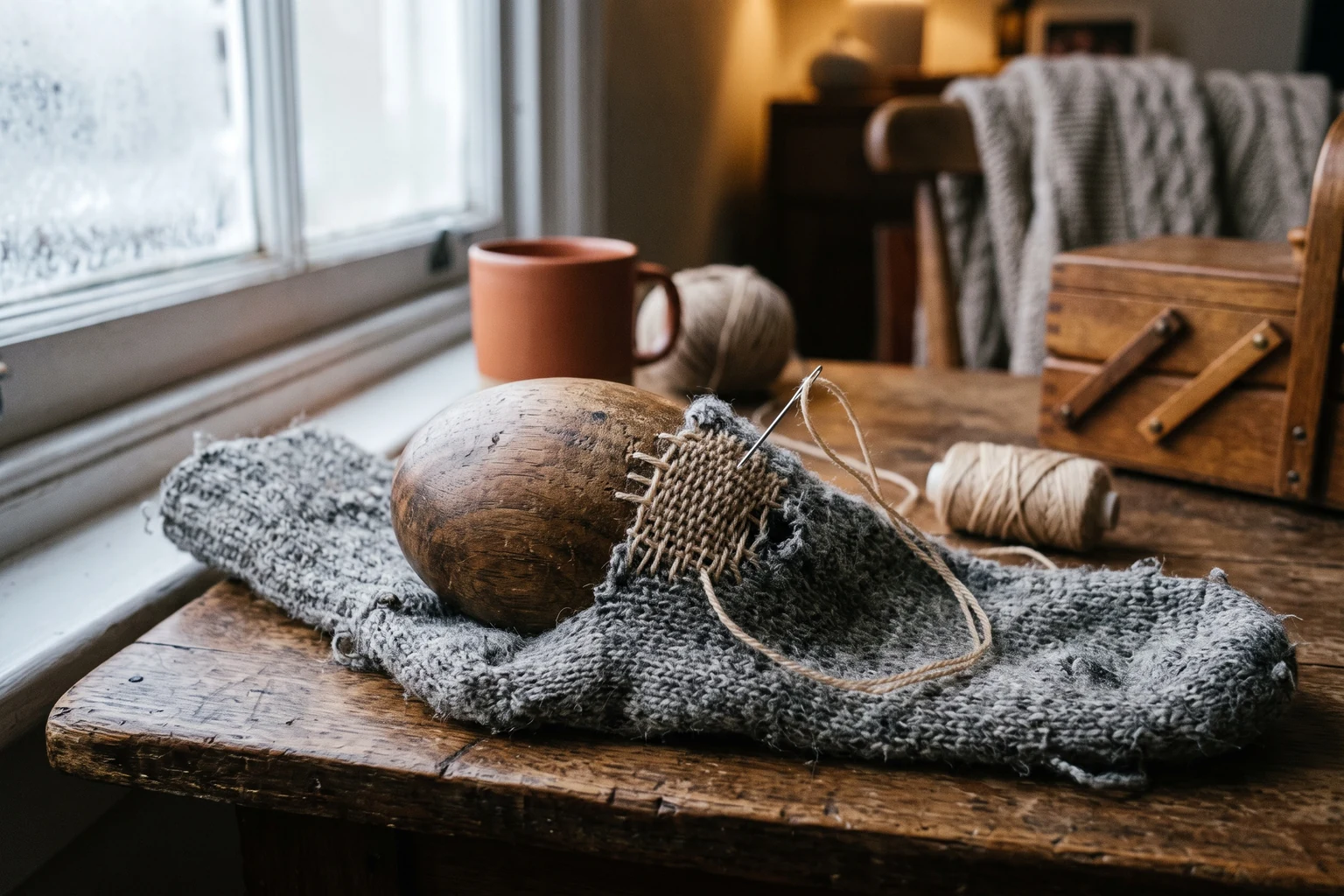
The hole announces itself at the heel, or under the ball of the foot, wherever the sock has spent itself against you — a thinning first, the wool gone sheer and pale so the skin shows through grey, and then the give, the threads parting, a raw oval of nothing rimmed by the frayed ends of what used to hold. You put your finger through it. There’s a small foolish intimacy in that, the finger where the heel goes, the sock inside out over your hand like a puppet.
You reach for the egg. A darning mushroom, wooden, smooth as a river stone, worn shiny by other hands than yours — you push it up inside the sock until it fills the heel and stretches the hole flat and open over its curve, the thin wool drawn tight, the ragged oval held steady against the wood. Now you can see the whole of the damage, framed, taut, waiting.
You thread the needle with wool as close to the sock’s colour as the tin allows, and it’s never quite right, and that’s part of it — the darn will show, always shows, a patch of nearly-the-same laid into the weave, honest about itself. No knot. You run a few small stitches into the good wool around the hole to anchor the thread, and then you begin to build.
First the warp. You lay the needle back and forth across the hole in one direction — down through the sound wool on this side, a long float across the empty air of the hole, up through the sound wool on the far side, and back again, close beside the last, laying rail after rail of thread across the gap. You go a little into the good ground on each side, past the weak thinning wool, anchoring in cloth that can still hold, because a darn stitched only to the frayed edge tears out again the first day. The hole fills with parallel threads, a little raft of them, spanning the nothing.
Then the weft, and this is the part the hands enjoy. You turn the work a quarter and weave the needle through the warp threads you just laid — over one, under the next, over, under, all the way across — then back the other way, over where you went under, under where you went over, the needle nosing patiently through the shed of threads. Each pass you push up snug against the last with the needle’s tip, packing the weave tight. And a fabric grows where there was a hole. An actual small square of new-woven cloth, made right there on the wooden egg, thread crossing thread, filling the raw oval with something whole.
You watch it close. Row by row the empty middle shrinks, the woven patch spreading in from the edges until the last gap is a slit, then a line, then gone, and the darn sits there in the heel of the sock — slightly proud, slightly the wrong shade, a neat woven island in the knitted sea around it, plainly a repair and plainly sound. You run your thumb over it. It’s a little firmer than the rest, a little thicker, a small deliberate roughness under the foot that you’ll feel for a day and then forget.
You slide the mushroom out and the sock relaxes around the mend, and you turn it right-side out, and there it is, wearable again, good for another season of the same slow wearing-through that will, in time, thin the wool right beside the darn and start the whole thing over. You don’t hide the repair. You couldn’t if you tried. It shows in the heel like a scar shows, a made thing over a broken place, the near-matching wool declaring exactly where the sock gave out and exactly where a needle and a wooden egg and a quarter-hour brought it back.
Word, when there is word.