Essay XIV
The Patina of Worn Door Handles
The worn brass handle on a back door, its lacquer gone under a thousand grips: a patina nobody planned, the record of every hand that came home.
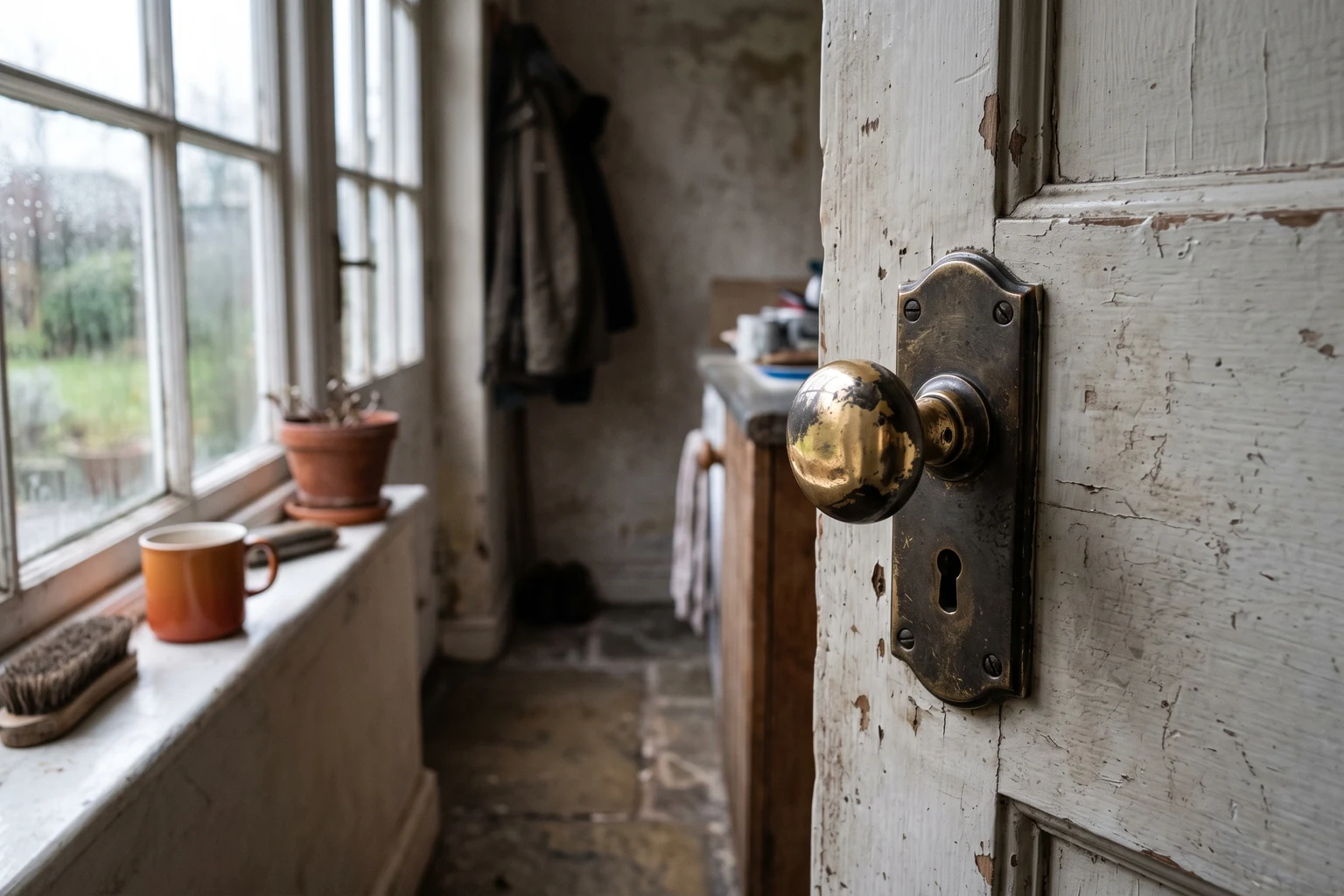
There’s a brass handle on the back door of my mother’s house. The kitchen light catches it in the evening, showing up the arc of dull shine beneath the keyhole—the patch where the lacquer gave up years ago, surrendered to the daily press of hands. You don’t notice it if you’re in a hurry. But if you come back after years away, as I did, the hand finds that smoothness before the eye does. A groove, not quite visible, but insistent under the thumb. The kind of wear you only get by accident. Nobody plans a patina.
The brass is cold at first touch. Not the biting cold of winter metal, but the dull chill of something that’s been waiting, indifferent to the warmth of hands. It yields slightly under your grip, not from softness but from memory—thousands of grips before yours. The patina is smooth, but not slippery. It’s the kind of smoothness that comes from friction, from the slow accumulation of oil from palms, the gradual wearing down of edges by the constant turn of hands. This isn’t the bright gleam of new brass. This is the quiet lustre of something that has been used, and used, and used again.
The thing about a worn door handle is that it never tells you whose hand did the most work. There’s no signature, no record of the day a child reached for it on tiptoe, or a parent left in anger, or a neighbour popped in to return a borrowed cup. Only the sum of it remains—a democracy of skin oils and small hesitations. The handle gives equal weight to the ceremonial and the mundane. First days of school, last walks with the dog, midnight returns after a late shift—all of them pressed into the brass with the same quiet insistence.
The handle doesn’t care who you are.
During the pandemic, we became suspicious of this kind of touch. Handles became sites of anxiety—carriers of threat rather than history. We learned to open doors with elbows or sleeves, to avoid the democratic press of the palm. For a while, the patina paused. But the friction never really goes away; it only waits. Even now, I find myself trusting the worn handle more than the new one. There’s a reassurance in knowing that others have passed this way, and survived.
I’ve noticed that in older buildings—churches, post offices, terraced houses—the most honest things are the ones that have been touched to the point of invisibility. That’s how you know a thing was needed. The new handles, bright and untouched, look nervous in comparison. They’re waiting for history to begin. There’s a temptation to romanticise this. I’ve seen the architectural salvage yards, the “distressed” brass shipped out by the lorry-load to be installed in restaurants and boutique hotels. Manufactured patina, as if you could buy the weight of other people’s lives. But real wear is slow, reluctant. It comes from repetition, not intention.
Consider the invisible lineage of touch. You move into an old building, a new flat, a borrowed space. Your hand finds the handle, and it fits. Not perfectly, perhaps, but it finds a familiar comfort in the worn groove. You are, in that moment, touching what thousands have touched before you. The postman’s grip, the hurried departure of a young lover, the weary entrance of a night-shift worker, the tentative twist of a child’s fingers. All of them, anonymous and long gone, have contributed to this communal skin you now inherit. You carry the weight of their passages without consent.
The locksmith can read a handle’s wear to know how a lock has been treated. But what does it mean to polish a worn handle? To erase the record, to reset to zero? It’s like buffing out the scratches on an old table, trying to make it look new again. But the scratches are part of the story. The patina is part of the story.
There’s a paradox in the smoothness. The patina is born of abrasion, of countless small resistances. It gets easier to turn as it wears, but the ease is only possible because others have done the hard work first. You inherit the friction of all those who came before, and you add your own, whether you mean to or not. There is no such thing as a truly solitary passage. Even alone at midnight, you’re accompanied by the ghosts of every hand that shaped the groove.
At home, the wear is more intimate. You can map the rise and fall of a family in the softness of a latch, the way the handle sits a little lower than it once did, sagging under the weight of years. My mother’s handle has a faint ridge where she pushes with her hip when her hands are full. Children’s sticky prints, the roughness of a workman’s grip, the tentative press of a visitor unsure whether to enter—each leaves something behind, though none of it lasts alone. The patina is collective, but it is also fragile. Polish it too hard and you erase the history. Leave it too long and it turns to grime, not memory.
The digital world promises frictionless passage. Passwords, keycards, automatic doors—no residue, no inheritance. Every entry wipes itself clean. But the body knows better. The mind may crave abstraction, but the hand remembers resistance. You can’t swipe a door open. You must lean into it, transfer your weight, accept the mild resistance. The handle teaches the virtue of thresholds, something our seamless world tries to erase.
The handle persists. The groove returns. Always returns.
The handle is a kind of secular sacrament. You don’t make it sacred by talking about it. The act is enough: hand meets brass, body crosses threshold. Something like prayer, if prayer were a matter of turning, entering, carrying the load of ordinary passage. Each grip is a repetition, not for the sake of ritual, but because life requires it. You don’t remember most of the times you open a door. The handle remembers for you.
Perhaps that is enough. To take hold, to cross, to leave a little of yourself behind—not as a monument, but as a smoothing, a softening, a record of passage. Not transcendence, but presence. The patina is not a triumph; it’s a testament. You are here, carrying the load of entrances and exits, inheriting friction, smoothing the brass for those who will come after.
You are not here to transcend the world. You are here to learn how to carry it. And sometimes, the world teaches you this lesson through a piece of brass, worn smooth by a million hands, each leaving a trace, each carrying a load, each passing through. Your body’s still here, wanting, needing, carrying. The weight of being here.
It always returns.
MEDIUM (Instagram/LinkedIn)
The brass handle on my mother’s back door has a patch beneath the keyhole where the lacquer gave up years ago. You don’t notice it if you’re in a hurry. But if you come back after years away, the hand finds that smoothness before the eye does. A groove, not quite visible, but insistent under the thumb.
The thing about a worn door handle is that it never tells you whose hand did the most work. There’s no signature. Only the sum of it remains—a democracy of skin oils and small hesitations. First days of school, last walks with the dog, midnight returns after a late shift. All of them pressed into the brass with the same quiet insistence.
There’s a paradox in the smoothness. The patina is born of abrasion, of countless small resistances. It gets easier to turn as it wears, but the ease is only possible because others have done the hard work first. You inherit the friction of all those who came before, and you add your own, whether you mean to or not.
The digital world promises frictionless passage. Passwords, keycards, automatic doors. No residue, no inheritance. But the body knows better. The hand remembers resistance. The handle persists. The groove returns.
Something like prayer, if prayer were a matter of turning, entering, carrying the load of ordinary passage. You don’t remember most of the times you open a door. The handle remembers for you.
SHORT (Twitter/X)
The brass handle on my mother’s door has a groove worn by thousands of hands. You inherit the friction of all those who came before, whether you mean to or not. The patina is born of abrasion. It gets easier to turn as it wears, but only because others did the hard work first.
Word, when there is word.