Essay XXI
The Weight of Groceries Without Bags
Three blocks with your arms full and no bag—the milk cold against the forearm, the bread taking its dent—and the plain re-learning of what carrying is.
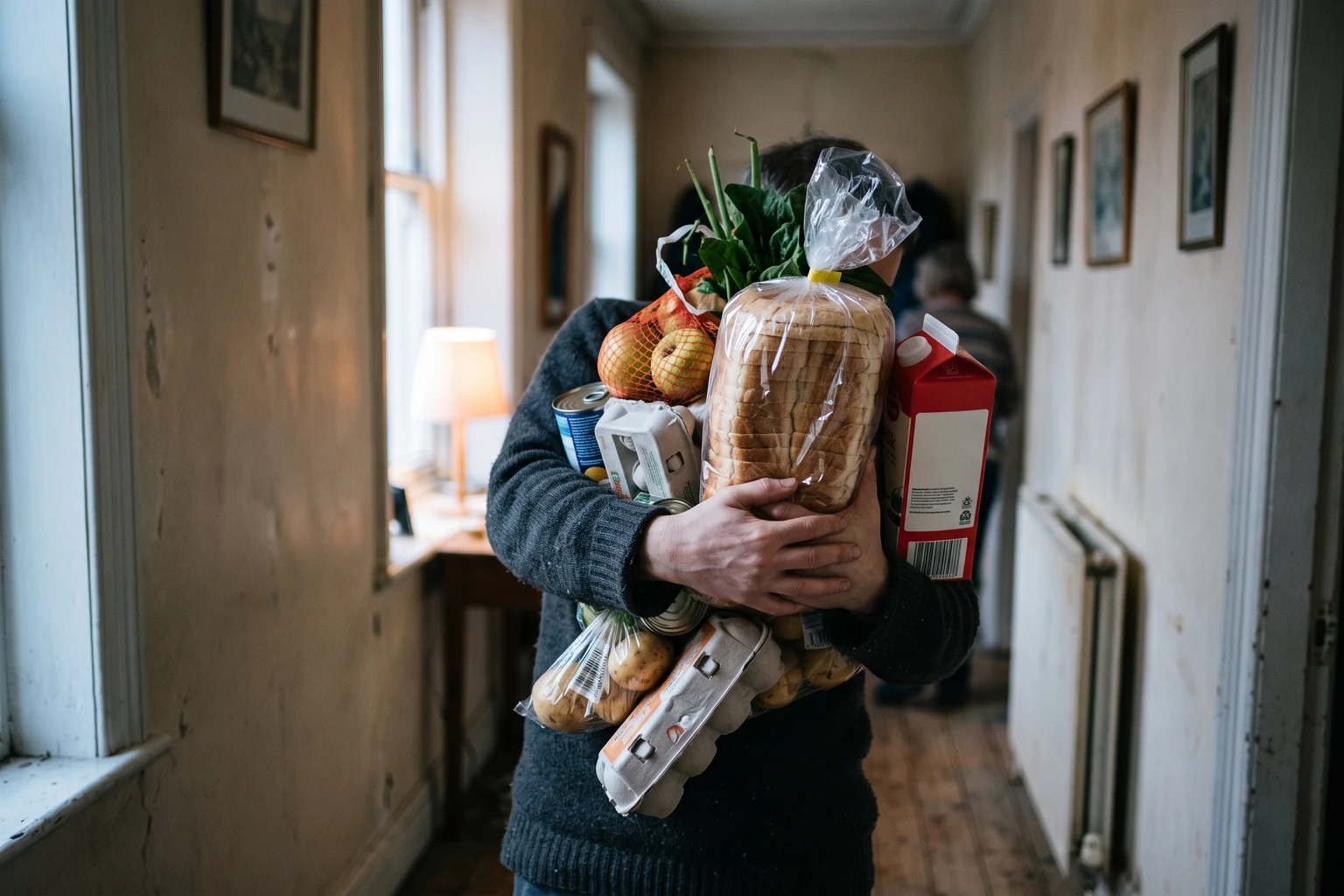
Three blocks. That’s all. Three blocks with your arms full of groceries, and you remember what carrying means.
The milk carton, cold and sweating, presses against your forearm. The bread yields against your ribs—soft, already bearing the dent it will wear home. An apple rolls into the crook of your elbow and settles there, finding its place. The tin of tomatoes leaves its ring in your palm. Your body isn’t a container. It’s a landscape, discovering its own pockets and valleys to hold what it must.
The negotiation begins immediately. Not a decision, exactly. More like what water does, finding its level. Your spine reconfigures—slight lean left, then a compensating shift right. Shoulders drop and roll forward. Hips adjust. The body, cleverer than the mind, recruits muscles you’d forgotten: the webbing between thumb and forefinger, the inside of the wrist, that small stabilizing tension in the lower back. You become a different animal. One that moves with deliberate attention, aware of every shift in the load.
This is what happens when you remove the intermediary. The bag—plastic, paper, canvas—it creates a kind of sterile field. Everything becomes “groceries,” a unit of weight swinging from your hand. But pressed against your chest, each thing announces itself. The chill of the tin seeping through your shirt. Condensation from the milk leaving its damp geography on cotton. The ridge of the cereal box digging into your forearm, writing its temporary signature in flesh.
You’re not carrying groceries. You’re carrying this lemon, this bag of rice, this particular jar of honey. Each with its own weight, temperature, texture. The transaction becomes intimate. Unbuffered. You receive the imprint of their existence directly onto your skin.
Three blocks isn’t far. Until you carry something. Then distance becomes eventful. Every step requires minor recalibration—a can sliding, an apple threatening escape, the loaf conforming to the architecture of your ribs. Your attention is consumed entirely by the immediate physical problem. The mind cannot wander to tomorrow’s meeting or yesterday’s argument. It’s tethered to this: the weight, the balance, the next step.
This isn’t mindfulness. Mindfulness is something you try to do. This is something being done to you. A forced grounding. The body’s own liturgy of necessity.
And the way you carry them—it matters. Objects swinging from your hand exist at arm’s length, separate. But objects pressed against your chest are brought into a different proximity. The posture is protective, almost maternal. Like carrying a sleeping child or cradling something precious. The weight becomes something you shelter, not just bear. Changes the nature of the burden itself.
Before bags, before baskets even, how did we carry grain from field to home? The body as the first vessel. Women carrying children on one hip, market goods on the other. The same motion, the same accommodation. Then containerization arrived—military logic applied to domestic life. Everything standardized, stackable, removed from human scale. The supermarket bag as the domestic equivalent of the shipping container. Both promising the same thing: frictionless transfer.
We’ve become very good at containing things. Not just groceries. Time gets containerized into productivity blocks. Relationships into networks. Experience into content. We smooth out the friction, the awkwardness, the specific gravity of living. The bag is just one small expression of this larger logic. This distance we’ve engineered between ourselves and the weight of things.
A person struggling with an armload of groceries is visibly engaged in the problem of their own sustenance. No sleek efficiency here. The possibility of failure—dropped onion, rolling apple, burst carton—is present for all to see. Someone might hold a door. Or simply nod in recognition. We see ourselves in that small struggle. The bag, by contrast, is a kind of armor. It contains the mess, projects competence. Allows for anonymous passage through the world.
To carry without one is to admit need. To display your limits. To be seen obtaining the basics of survival, awkwardly, humanly. It reintroduces friction into the polished surface of daily transaction.
The Incarnation as anti-containerization. God refusing to remain abstract, taking on weight and temperature and hunger. Or think of manna—gathered daily, only what the body could carry. The biblical suspicion of storage, of too much distance between need and provision. As if the weight itself were part of the teaching.
At your door, finally, the relief of setting it all down. Arms tingling. Chest marked with the geometry of the load. The bread slightly compressed. Your shirt carrying the faint scent of onion. The ache in that web of muscle between thumb and forefinger—a specific ache that belongs only to carrying. Your forearms will remember this for days. The body keeps receipts. Always keeps receipts.
You learn your carrying capacity not through calculation but through the specific failure point of your actual arms. Through the particular moment when the milk starts to slip, when the balance fails. This knowledge can’t be abstracted. It has to be lived, carried, endured.
We chase efficiency. We optimize. We try to rise above the mess, the weight, the friction. But the body’s still here. Wanting, needing, carrying. It refuses to transcend. It insists on the specific gravity of being here.
Three blocks without bags. Such a small thing. But small things are where the world reveals itself. In the weight against your ribs. In the cold of the milk through cotton. In the way your body knows how to redistribute a load without being taught.
You are not here to transcend the world. You are here to learn how to carry it.
The weight returns. Always returns.
MEDIUM (Instagram/LinkedIn)
Three blocks with groceries in your arms. No bag. The milk carton cold against your forearm, bread compressing against your ribs, an apple finding its place in the crook of your elbow.
Your body knows what to do. Spine adjusts, shoulders roll forward, the small muscles between thumb and forefinger remember their purpose. You become a different animal—one that moves with deliberate attention to weight.
This is what we’ve containerized out of existence. The bag promises convenience but delivers distance. Everything becomes “groceries”—a unit, manageable. But pressed against your chest, each thing announces itself. The tin’s chill through your shirt. The bread conforming to your ribs. The specific weight of this lemon, this jar, this particular dozen eggs.
Objects swinging from your hand remain separate. Objects against your chest enter a different proximity. The posture changes—protective, almost maternal. You’re not just bearing weight. You’re sheltering it home.
The body keeps receipts. Your forearms will remember this for days. Small ache in the web of muscle that only comes from carrying. You learn your capacity not through theory but through the specific moment when the milk starts to slip.
We optimize everything now. Containerize time into slots, relationships into networks, experience into content. But the body insists on the specific gravity of being here. Refuses the abstraction.
Three blocks without bags. The weight returns. Always returns.
SHORT (Twitter/X)
Three blocks carrying groceries without a bag. The milk cold against your forearm, bread yielding to your ribs. Your body redistributing weight with each step, remembering what it is to carry. We containerized everything—time, relationships, experience. But the body insists on contact.
Word, when there is word.